
With applications spanning DeFi, NFTs, and cross-chain platforms, the Chainlink network has become an essential infrastructure layer in the crypto space. As of late January 2026, LINK was trading at around $11.52, with industry experts and many analysts predicting steady growth over the coming years if adoption and network utility continue to expand.
In this guide, we dive deep into Chainlink’s price history, technical trends, and expert predictions for 2026 through 2030. You’ll also learn what drives LINK’s value and which factors to watch in the short term to help you make informed investment decisions.
Chainlink (LINK) Overview
Chainlink is a decentralized oracle network that enables smart contracts to securely access external data. Since blockchains are closed systems, they can’t directly pull real-world information such as asset prices, interest rates, or event outcomes. Chainlink addresses this limitation by connecting on-chain smart contracts to off-chain data sources via a network of independent oracle nodes.
Its most widely used product is Chainlink Price Feeds, which major decentralized finance (DeFi) protocols rely on to secure billions of dollars in total value locked (TVL). These feeds aggregate data from multiple sources to mitigate the risk of manipulation and improve accuracy.
Beyond price feeds, the Chainlink platform has expanded into areas such as verifiable randomness (VRF), smart contract execution automation, and cross-chain communication via its Cross-Chain Interoperability Protocol (CCIP).
In addition to these, Chainlink has a native utility token, LINK. The token is used to pay node operators for providing data services. Over the years, LINK has become a leading crypto investment due to its crucial role in the DeFi ecosystem, particularly for investors and developers.
Chainlink Price History and Performance
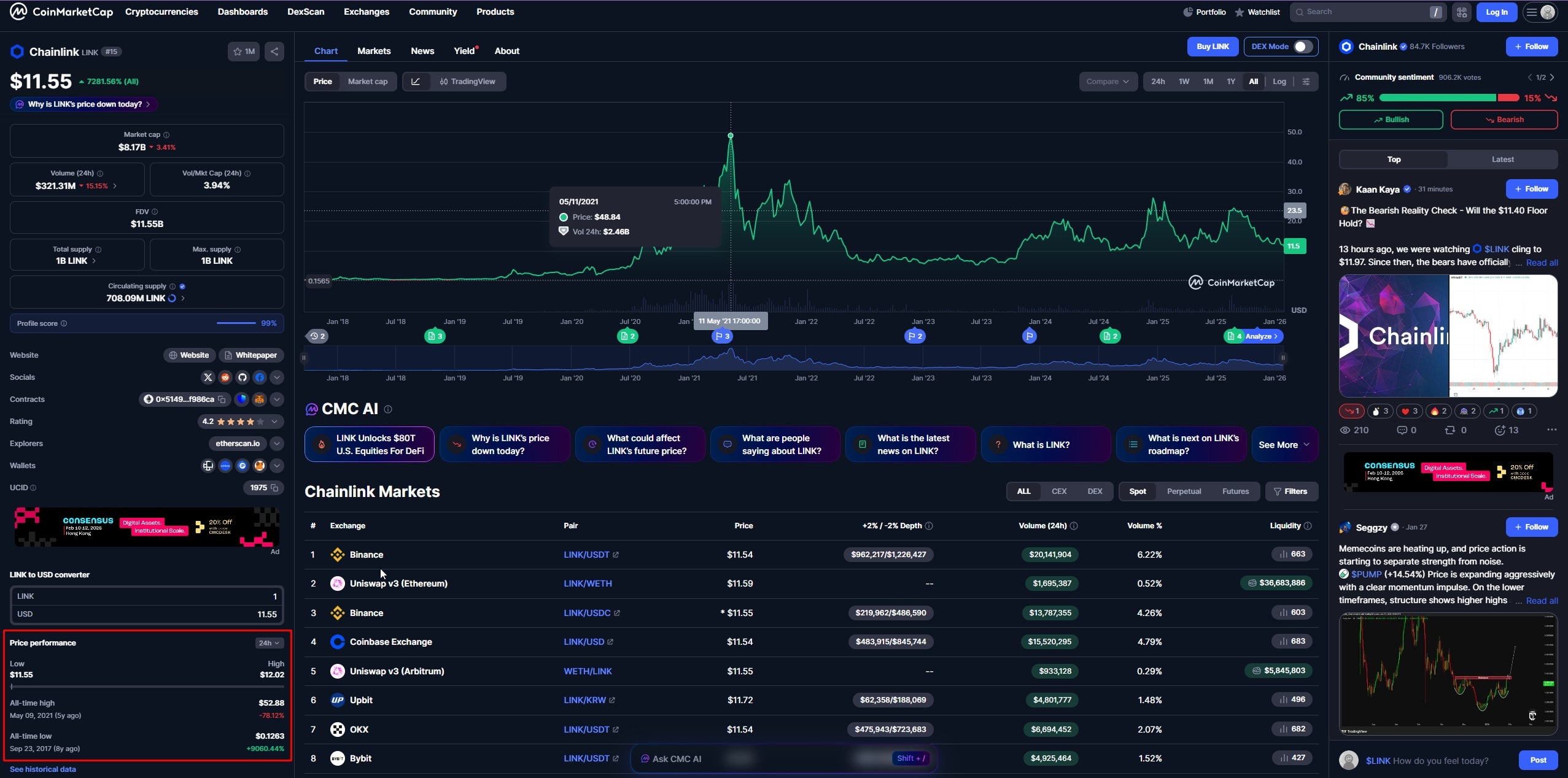
Here is a breakdown of how the LINK token has performed in the past to help you understand patterns in on-chain activity.
- Launch and All-time Low (2017): LINK first traded at roughly $0.12-$0.13 shortly after listing in September 2017, marking its all-time low.
- 2018 – 2019 Growth: LINK’s average price remained under $2 through 2018, before beginning a meaningful rise in 2019, where it climbed to an average of $4 as adoption of oracles began.
- 2020 Breakout: LINK gained strong momentum during the 2020 bull market, rising from under $2 early in the year to $16.92 by August on oracle demand, with annual returns at 500%+.
- 2021 All-Time High: The token reached its all-time high of approximately $52.88 on May 10, 2021, driven by broad crypto market bullishness and heavy DeFi demand.
- 2022 Bear Market: During the 2022 downturn, LINK experienced a significant correction, similar to other altcoins, falling sharply from early-year levels to about $6.02 by year-end.
- 2023 Recovery: Chainlink (LINK) rebounded in 2023, with prices climbing back to about $15 by year-end, reflecting renewed interest in oracle use cases and overall market stabilization.
- 2024 – 2025 Range: Prices continued to fluctuate at $20+ amid broader market volatility. As of late January 2026, LINK was trading in the $10-$14 range, well below its 2021 peak.
LINK Current Market
As of the most recent data, Chainlink (LINK) is trading at approximately $11.52, reflecting market activity in early 2026, when broader crypto volatility is suppressing many altcoins. LINK’s circulating supply is roughly 708 million of its 1 billion maximum supply, meaning about 70% of all LINK is currently in circulation.
This keeps the token’s market capitalization at $8.17 billion, placing it among the top cryptocurrencies by market cap. Meanwhile, LINK’s daily trading volume was approximately $302 million as of writing, indicating active liquidity across major crypto exchanges. Although it has sustained interest across the market, LINK’s price over the past year remains below its 2021 all-time high of $52.88.
How Do NFTPlazas Experts Predict Chainlink’s Price in the Future?
At NFTPlazas, Chainlink (LINK) price forecasts are based on a combination of utility, market data, historical performance, technological developments, and user adoption. We begin by evaluating broader crypto adoption, including the extent to which Chainlink’s oracle services are used across DeFi, NFTs, gaming, and other Web3 sectors.
This is because, beyond hype, sustained usage is a key driver for long-term demand for any digital asset. We also consider LINK’s token supply and distribution model, including its fixed supply, circulating supply ratio, and the impact of staking on reducing liquid tokens in the market.
Since no single factor can accurately predict the market behaviour of a crypto asset, we also monitor historical price trends and market cycles to identify key accumulation and distribution zones, while broader crypto market conditions provide context for timing and volatility.
LINK Technical Analysis
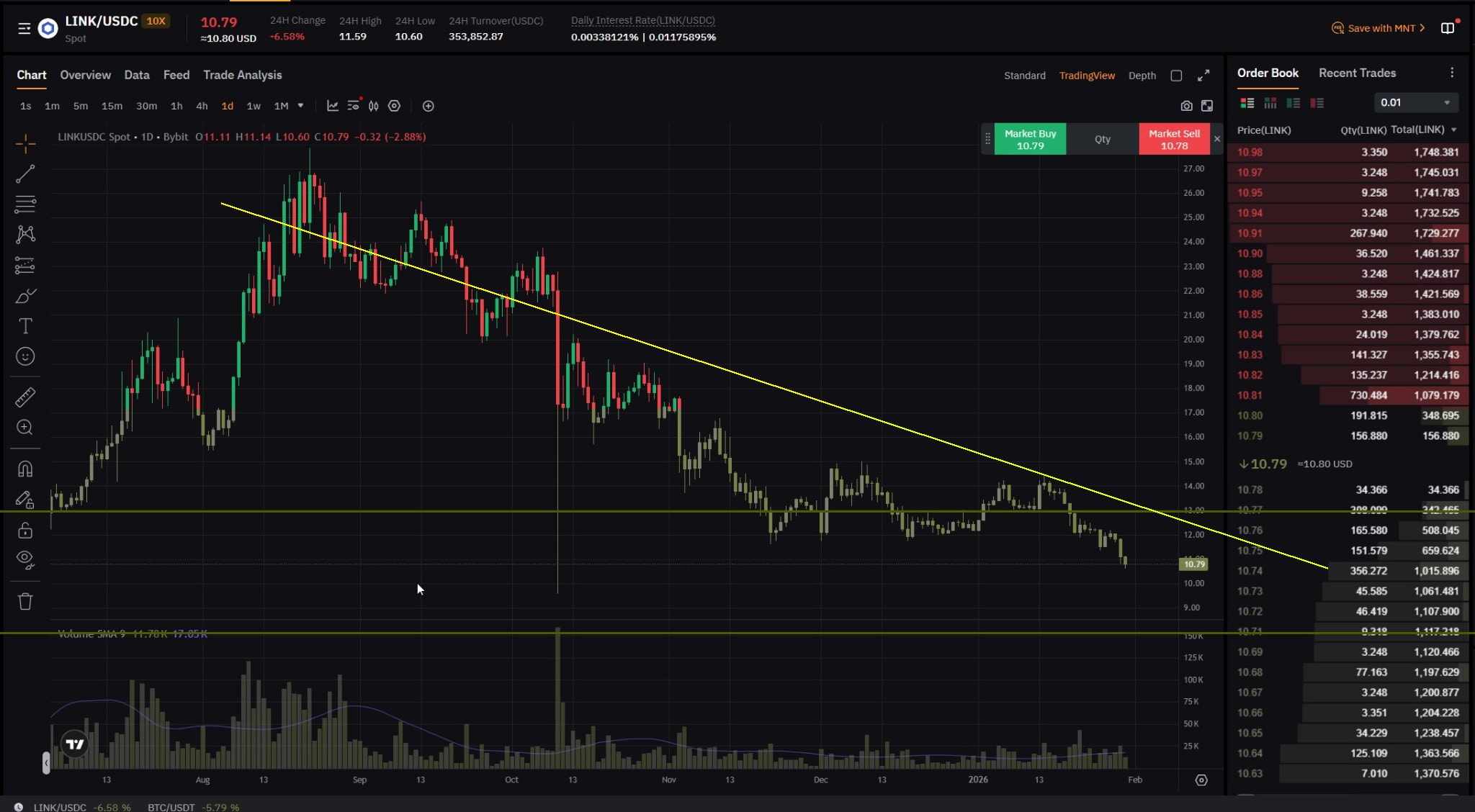
Recent price action indicates Chainlink is under short-term bearish pressure after a breakdown below key support levels. LINK failed to hold the $11.70 – $11.80 zone, an area that previously acted as a demand floor, confirming a shift in near-term market structure. Once the price moved below this level, selling momentum increased, pushing LINK toward lower local lows.
Trading volume also spiked during the initial drop, indicating strong sell-side participation and liquidations, while subsequent consolidation has occurred on relatively low volume. This imbalance suggests hesitation from buyers rather than a clear reversal signal.
However, oversold readings alone are not sufficient to confirm a sustained bounce, so here is a breakdown of LINK’s support and resistance levels and how these affect the token in the short and long-term.
Key Price Levels
Current trading range sits between $11.50-$12.00, with minor resistance near $12.40 – $12.75 and short-term support near $11.30 – $11.60 based on recent pivot point data. The most critical zone is around $11.40, which represents a local low formed after the recent breakdown.
This level acts as a short-term inflection point. If LINK holds above this level, it could allow for stabilization, while a decisive break below would likely open the door to lower psychological levels. Above the current price, the $11.70-$11.85 range has become resistance following the breakdown.
This area now constitutes the first major hurdle to any recovery attempt. A sustained move above the resistance zone would be needed to shift short-term momentum back in favor of buyers.
Support Levels
Support levels refer to price points at which buying pressure historically steps in and prevents deeper declines. For LINK right now, many analysts are watching a few key support thresholds:
- $11.74 – $12.00 zone, where multiple recent lows have appeared, acting as immediate downside protection.
- $12.50 area, repeatedly tested since late December 2025 as a pivot point for rebound attempts; a breakdown below this could signal broader weakness.
- In lower volatility scenarios, deeper support may be tested near $11.00, a psychological level that could attract accumulation if broader markets retreat.
Resistance Levels
Resistance levels are where selling interest tends to cap upward moves. For LINK, the notable resistance zones include:
- $12.40 – $12.75 as current near-term ceilings on momentum charts.
- $16.00 – $16.80, a historically tested zone where price has encountered selling pressure, with breakouts above this often signaling broader upward momentum.
- $18.00 – $20.00 a medium-term resistance range that aligns with moving average clusters and psychological round numbers that attract profit-taking.
If LINK fails to break above these resistance levels, it would likely stay at that range or push toward another downside test, leading to strong reinforcement for the current bearish structure.
Chainlink Price Prediction 2026
| Month | Minimum Price (USD) | Average Price (USD) | Maximum Price (USD) |
| January | $13.30 | $14.31 | $14.09 |
| February | $13.81 | $14.79 | $14.88 |
| March | $14.33 | $15.28 | $15.67 |
| April | $14.85 | $15.77 | $16.46 |
| May | $15.36 | $16.25 | $17.25 |
| June | $15.88 | $16.74 | $18.04 |
| July | $16.40 | $17.23 | $18.82 |
| August | $16.91 | $17.71 | $19.61 |
| September | $17.43 | $18.20 | $20.40 |
| October | $17.95 | $18.69 | $21.19 |
| November | $18.46 | $19.17 | $21.98 |
| December | $18.98 | $19.66 | $22.77 |
Chainlink Price Prediction 2027
| Month | Minimum Price (USD) | Average Price (USD) | Maximum Price (USD) |
| January | $19.74 | $20.43 | $23.63 |
| February | $20.49 | $21.19 | $24.50 |
| March | $21.25 | $21.96 | $25.36 |
| April | $22.01 | $22.72 | $26.22 |
| May | $22.76 | $23.49 | $27.09 |
| June | $23.52 | $24.26 | $27.95 |
| July | $24.28 | $25.02 | $28.81 |
| August | $25.03 | $25.79 | $29.68 |
| September | $25.79 | $26.55 | $30.54 |
| October | $26.55 | $27.32 | $31.40 |
| November | $27.30 | $28.08 | $32.27 |
| December | $28.06 | $28.85 | $33.13 |
Chainlink Price Prediction 2028
| Month | Minimum Price (USD) | Average Price (USD) | Maximum Price (USD) |
| January | $29.02 | $29.84 | $34.43 |
| February | $29.98 | $30.83 | $35.72 |
| March | $30.93 | $31.82 | $37.02 |
| April | $31.89 | $32.80 | $38.31 |
| May | $32.85 | $33.79 | $39.61 |
| June | $33.81 | $34.78 | $40.90 |
| July | $34.76 | $35.77 | $42.20 |
| August | $35.72 | $36.76 | $43.49 |
| September | $36.68 | $37.75 | $44.79 |
| October | $37.64 | $38.73 | $46.08 |
| November | $38.59 | $39.72 | $47.38 |
| December | $39.55 | $40.71 | $48.67 |
Chainlink Price Prediction for 2026, 2027, 2028, 2029, and 2030
| Year | Price Prediction (USD) |
| 2026 | $19.50 |
| 2027 | $27.80 |
| 2028 | $40.70 |
| 2029 | $55.90 |
| 2030 | $72.40 |
What Factors Influence Chainlink’s Price?
The factors that influence Chainlink’s price include the following:
- Oracle adoption and network usage: Chainlink currently has strong fundamentals, but as more DeFi platforms, NFTs, gaming, and enterprise projects rely on Chainlink’s oracle services, demand for LINK tokens will increase.
- Staking participation: LINK holders can stake their tokens to secure the network and earn rewards. Higher staking rates reduce the number of tokens in circulation, which can support upward price pressure.
- Market sentiment: Like all digital assets, LINK’s price is influenced by overall market trends, investor sentiment, Bitcoin dominance, and investors’ risk appetite.
- Technological advancements: Innovations such as CCIP (Cross-Chain Interoperability Protocol), Verifiable Random Functions, and new oracle network features can increase token utility.
- Regulatory environment and macroeconomic factors: Global crypto regulations can impact adoption, investor confidence, and token liquidity. Additionally, Interest rates, inflation, and global markets indirectly influence crypto investment flows, affecting LINK’s price.
Factors such as market sentiment, regulatory environment, staking, and network usage influence all crypto assets. Compare LINK with XMR or SUI in this detailed XMR price prediction and SUI price prediction to understand how they react to these factors.
Short-Term Chainlink Price Predictions – What to Watch for Today and Tomorrow
Chainlink (LINK) is trading at $11.55 today, down 2.59% over the past 24 hours. Bearish momentum below the 50-day moving average of $12.87 suggests the token may continue consolidating or test lower support levels.
Short-term forecasts indicate limited upside to around $11.60 tomorrow if trading volume remains subdued, while a break above $12.00 could open the path toward the $13.00 resistance.
Key factors to monitor include volume spikes above the daily average of $16.3 million and the integrity of $11.61 support, as a breakdown here could accelerate selling toward $10.50. Conversely, a recovery of the RSI above 45 may indicate the potential for a short-term rebound.
FAQs
LINK is considered a good investment among traders and crypto investors. It is one of the leading infrastructure tokens in the crypto space, powering decentralized oracles across DeFi, NFTs, and other Web3 applications. Even with this optimism, its long-term investment potential depends on continued adoption, staking participation, and broader market conditions.
Reaching $100 is possible on paper, that is, if LINK’s adoption grows significantly, network usage expands, and macro crypto conditions are favorable. However, based on expert predictions and community sentiment, it could take a few years for LINK to reach $100.
A $1000 price for Chainlink (LINK) is extremely unlikely under current market conditions. Achieving such a level would require broader crypto adoption, token scarcity, and sustained bullish cycles in the broader crypto market. This is still highly speculative.
Price predictions for Chainlink (LINK), like those for any crypto asset, are inherently uncertain. Analysts use a combination of technical indicators, historical trends, and adoption metrics to make projections; however, unexpected market shifts, regulatory changes, and macroeconomic factors can significantly alter outcomes. For this reason, we encourage you to see predictions as informed estimates rather than guarantees.