

Whether you’re sending, receiving, or simply holding crypto, you’ll need a private key to secure your wallet, prove ownership, and ultimately control your assets. A private key is a long, randomly generated alphanumeric code that works with a public key to secure your assets and authorize transactions.
In this article, we’ll dig deeper into the concept of private keys, how they work, and their significance. In addition, we’ll provide a step-by-step guide on private key management, threats to keys, and best practices to keep crypto funds safe.
What Is a Private Key?

A private key is a secret cryptographic key used to access and control assets in a cryptocurrency wallet. It is usually a long alphanumeric code that is generated by a cryptographic algorithm when a crypto wallet is created.
The private key works together with a public key to enable secure blockchain transactions. While the public key can be shared openly, the private key must always remain secret to prevent unauthorized access.
Furthermore, the public key is used to create wallet addresses so others can receive funds, while the private key is used to approve transactions and create digital signatures that prove only the holder made the action of that key.
How Does a Private Key Work?
A private key works through asymmetric cryptography, where it pairs with a public key using a one-way mathematical function, commonly elliptic curve multiplication in blockchains like Bitcoin and Ethereum. This allows the public key to be derived from the private key, but not the other way around.
Specifically, the private key is used to create digital signatures that confirm the request came only from the holder, while the corresponding public key verifies the signature without exposing the secret key. During a transaction, the wallet signs the data using the private key and an encryption algorithm, producing a digital signature that the network checks using the public counterpart before accepting the encrypted data.
As a result, this system ensures data security because the private key is stored in a secure location and never shared online, helping prevent unauthorized access to the wallet and its crypto funds.
Benefits of Private Key Encryption
1. Performance and Speed
Private key encryption, often used in symmetric encryption, is known for its speed and efficiency when handling large amounts of data. Because the same key is used for both encryption and decryption, the encryption algorithm requires fewer computational steps than asymmetric encryption, which uses two keys. Therefore, systems that rely on strong symmetric key encryption, including stream ciphers, can process encrypted data quickly while maintaining high data security.
2. Data Integrity
Private key systems help protect data integrity by ensuring that information has not been altered during transmission. When an encryption algorithm encrypts information, the receiving party can decrypt the information using the secret key and confirm that the data matches the original message. If the encrypted data has been modified or corrupted, the decryption process will fail, signaling a potential security issue.
3. Confidentiality
One of the biggest advantages of private key encryption is confidentiality. Since the secret key is known only to authorized parties, unauthorized users cannot easily decrypt messages or access the protected information. As long as the key remains secure, the encryption system protects sensitive data from exposure across the internet or other
4. Authentication and Integrity
Private key systems also support authentication and integrity, especially when combined with public key encryption. In many security systems, the private key is used to create digital signatures, which allow others to verify identity using the corresponding public key. This process confirms that the message came from the correct user and that the data was not altered after it was sent.
How Private Keys Are Used in Practice
1. Decrypting Messages or Data
A private key can be used to decrypt data that was encrypted with a public key. In asymmetric encryption, the sender encrypts information using the receiver’s public key, and the receiver then uses the private key to decrypt the data and read the original message. As a result, this method ensures that only the intended user with the correct key can access the information.
2. Creating Digital Signatures
Another common use of a private key is to create digital signatures. When a user signs a file, message, or transaction, the system uses the private key and an encryption algorithm to generate a signature tied to the corresponding public key. Consequently, anyone with the corresponding public key can verify that the signature is valid, confirming that the message came from only the holder of the key.
3. Accessing Secure Systems
Private keys are also used to access protected systems and services across the internet. For example, servers often rely on SSL certificates issued by a certificate authority. In these cases, systems use public and private key pairs, with the private key stored in a secure location on the server, enabling encrypted connections and protecting sensitive data.
4. Authorizing Cryptocurrency Transactions
In cryptocurrency networks, a private key is essential for controlling a crypto wallet and managing crypto funds. When a user sends a transaction, the wallet uses the private key to generate a digital signature that proves ownership of the funds. The blockchain network verifies the signature using the public key before allowing the transaction to move forward.
Because of this system, losing access to a private key means losing control of the associated cryptocurrency wallet. For this reason, many users store keys in cold wallets, especially hardware wallets like Ledger NanoX instead of leaving them exposed in a hot wallet or other software connected to the internet.
Private Keys vs. Public Keys: What’s the Difference?
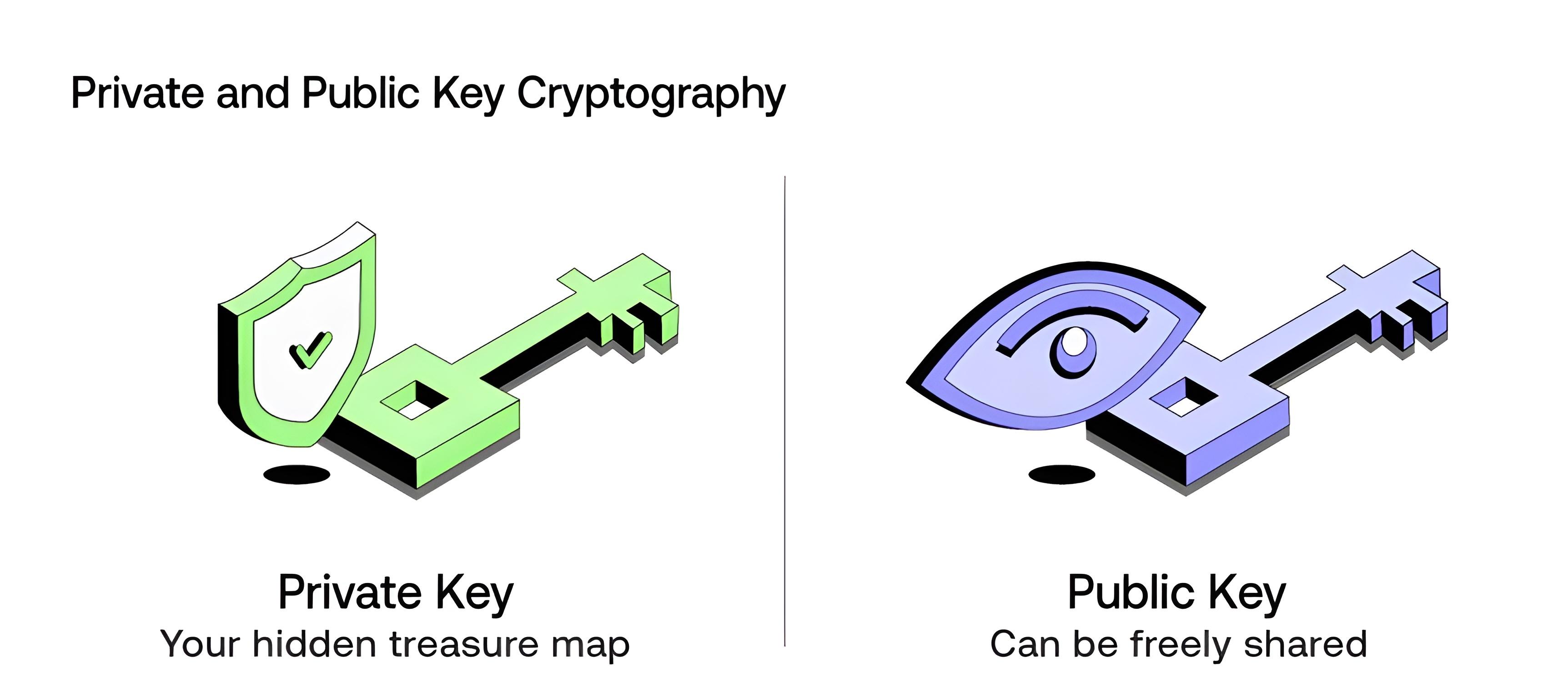
Private keys and public keys form a key pair in asymmetric encryption with distinct roles. With a private key, only the holder can access the wallet, and exposure allows anyone to move crypto funds. On the other hand, the public key is the public counterpart used to receive funds and verify digital signatures without exposing the private key.
Here is how these two keys differ:
| Aspect | Public Key | Private Key |
| Visibility | You can share your public keys with anyone | Private keys must be kept secret |
| Primary Role | Encrypts data or verifies signatures | Decrypts data or signs transactions |
| Generation | Public keys are derived from private key via one-way math | Generated first as the source |
| Usage Example | Receive crypto like a wallet address | Spend crypto or access funds |
| Security | No risk if you share it with others | If your private keys are compromised, you’ll lose access to your wallet and funds |
| Performance | Slower, computationally intensive | Faster operations |
Private Keys vs. Passwords: What’s the Difference?
Private keys are used to sign transactions, decrypt messages, and control access to crypto wallets and secure systems. While a password provides authentication to an account or device and can usually be reset. Here is a breakdown of how they differ:
| Aspect | Private Key | Password |
| Type | Cryptographic string (e.g., 256-bit number) | Human-readable string of characters |
| Usage | Signs transactions, proves ownership (e.g., spend crypto) | Authenticates to accounts/services |
| Storage | User device/wallet only. Never share it with anyone | Often hashed on servers; resettable |
| Security Model | Asymmetric crypto; irreversible if lost | Symmetric/shared secret; vulnerable to breaches/phishing |
| Recoverability | None. Permanent loss of assets | Reset via email/SMS/support |
| Vulnerability | Theft grants full control | Brute-force, keylogging, reuse attacks |
| Crypto Relevance | Essential for wallets like Tangem/Ledger | Protects exchange logins, not funds |
Threats to Your Private Keys
- Malware and viruses: Software can target private keys stored on computers or mobile devices.
- Phishing attacks: Fake websites or messages trick users into revealing private keys or passwords.
- Hardware theft: Losing devices that store private keys, including hardware wallets or hot wallets, exposes funds.
- Weak storage practices: Storing private keys in plain text, on the internet, or in easily accessible locations.
- Human error: Mistyping, misplacing, or failing to back up private keys can result in permanent loss of access.
- Keylogger software: Programs that record keystrokes can capture private keys as they are entered into software wallets.
- Social engineering: Attackers manipulate users into revealing their private keys or other sensitive information.
Private Key Management: Challenges and How to Keep Your Keys Secure
Challenges
- Risk of Loss: If a private key is lost, access to associated crypto assets or data is permanently gone, with no way to recover it.
- Susceptibility to Theft: Private keys stored insecurely can be stolen by hackers, malware, or phishing attacks.
- Human Error: Mistakes such as misplacing hardware wallets, writing keys down insecurely, or sharing keys unintentionally can compromise security.
- Complexity of Management: Users holding multiple keys across different wallets or platforms may struggle to track and manage them safely.
How to Keep Your Keys Secure
- Hardware Wallets: Store private keys offline in physical devices, reducing exposure to online threats.
- Encrypted Backups: Create secure, encrypted backups of keys in multiple safe locations to prevent loss.
- Multi-Signature Wallets: Require multiple private keys to authorize transactions, minimizing the impact of a single key compromise.
- Key Management Software: Use specialized software to securely generate, store, and manage private keys with strong encryption.
- Avoid sharing keys: Never give your private keys to anyone, including friends or service providers, and do not store them on shared or cloud devices prone to breaches.
- Cold Storage: Cold wallets are one of the safest ways to secure your cryptocurrencies. You can keep the majority of your funds offline, connected only when needed, to prevent constant exposure to online threats.
Conclusion
In sum, a private key is the core element of any cryptocurrency wallet and the foundation of data security in blockchain systems. It allows you to control crypto assets, create digital signatures, and authorize transactions, while the public key verifies actions without exposing the secret key. To protect your keys and account, store it offline in hardware wallets, have secure backups, and use strong encryption algorithms.
FAQs
Most crypto wallets allow users to view the private key in the wallet settings. For hardware wallets, the key is stored securely offline, and the wallet provides a method to safely reveal it. Exposing the private key outside a secure device increases the risk of theft.
Yes, a private key can be compromised if stored in software connected to the internet, through malware, phishing attacks, or social engineering. Using offline storage, such as hardware wallets or cold storage, significantly reduces risk.
A lost private key cannot be recovered without a backup. Proper private key management requires creating secure backups in multiple secure locations and using strong encryption algorithms for digital copies.
No. A password authenticates access to an account or device and can often be reset. A private key is a cryptographic key used to control a cryptocurrency wallet, sign transactions, and protect encrypted data. Losing a private key results in permanent loss of crypto funds.
A private key is a single cryptographic key that allows control of a wallet and authorization of transactions. A seed phrase is a backup of multiple private keys, typically generated when creating a wallet, that can be used to restore access to all keys in case of device loss.