Base Network is one of the most active environments for gaming and NFT experimentation. The network is backed by Coinbase and stands out for combining low fees, high throughput, deep liquidity, and direct access to a massive consumer user base. Since you’re exploring the Base network, it is only right that you know the ins and outs of the ecosystem.
Hence, this analysis explores the best gaming and NFT projects on Base in 2026, the infrastructure powering them, and why the network is becoming a serious contender in Web3 gaming.
What Is the Base Network?
The Base Network is a high-performance Ethereum Layer2 (L2) blockchain developed and incubated by Coinbase, one of the largest regulated crypto exchanges. Launched in August 2023, Base Chain was designed to solve two core limitations of Ethereum’s mainnet—high fees and slower transaction throughput—while maintaining Ethereum’s security guarantees.
At its core, Base network is a modular blockchain and operates as an optimistic rollup: a scalability technique that processes transactions off Ethereum’s Layer-1 before batching and settling them on the main chain.
This modular mechanism lowers gas costs and speeds up transaction finality, making Web3 interactions more affordable and responsive for users and developers on the network.
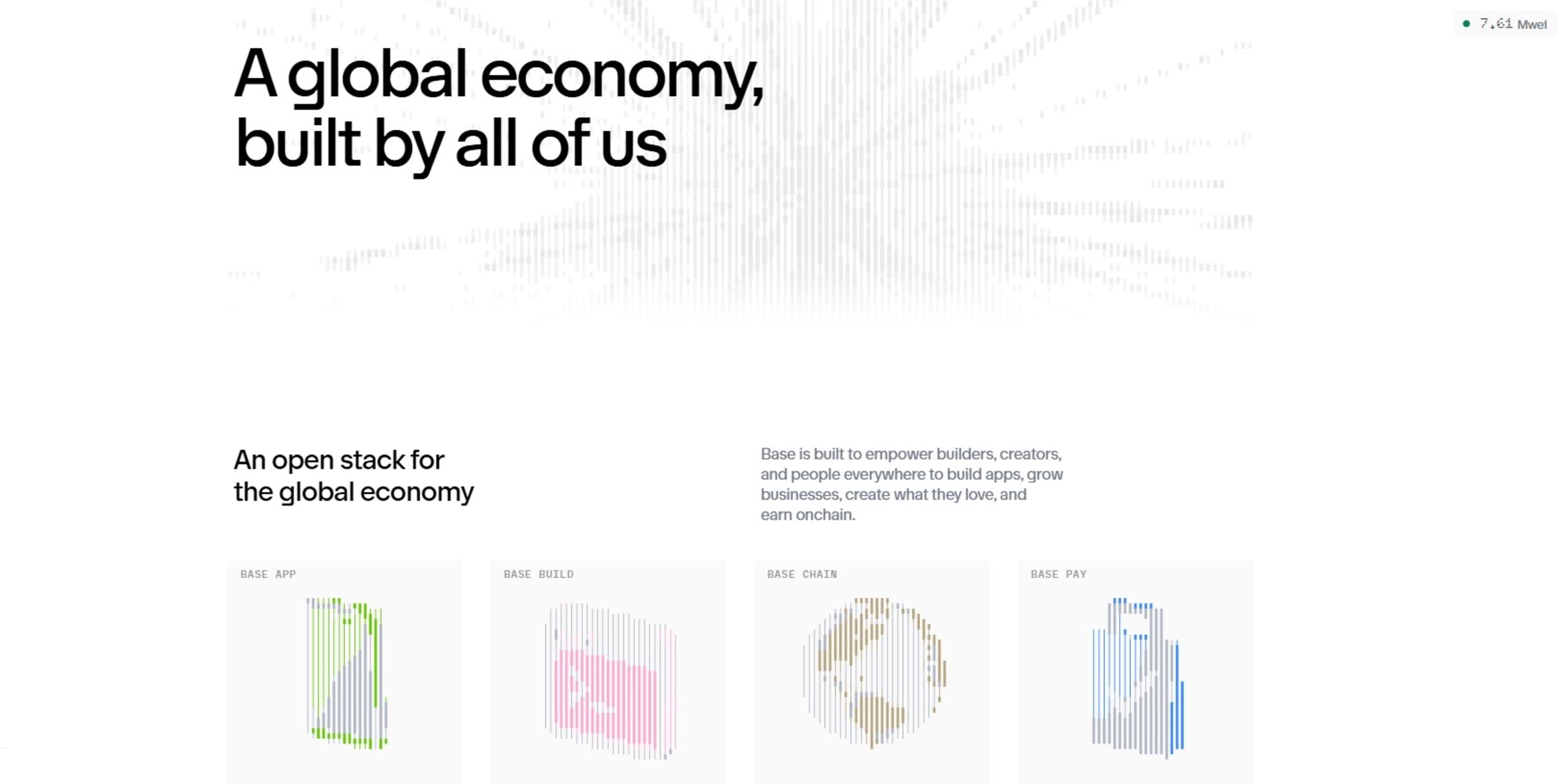
Base was built using the OP Stack, an open-source framework developed in collaboration with Optimism, another leading Ethereum L2 solution. This shared architecture ensures full EVM compatibility, meaning builders can write and deploy smart contracts on Base using the same tools and languages they use on Ethereum.
Unlike many blockchains that have their own native token, Base does not currently issue a separate token; instead, it uses ETH as its gas currency. The network leverages Coinbase’s ecosystem, including integrations with Coinbase Wallet and access to over 110 million verified users and $80 billion+ in assets under custody, to accelerate adoption and reduce onboarding friction.
Over time, the Base blockchain has grown beyond a simple scaling layer. It now supports a diverse ecosystem of decentralized applications (dApps), including marketplaces, decentralized exchanges, and NFT collections, which we’ll analyze further in this article.
Base Ecosystem Growth Metrics (On-Chain Signals)
Bridged Capital from Ethereum and Other Chains
Since launching its mainnet, the Base Chain has attracted substantial capital inflows from Ethereum and other blockchain networks. These inflows indicate that users are increasingly willing to move and deploy meaningful value on Base.
One way we see this is the network’s multi-billion-dollar bridged total value locked (TVL) of nearly $15 billion. Aside from the network’s bridged TVL, its current total value locked has surpassed $5 billion, positioning it as a major liquidity hub within the broader Ethereum Layer-2 landscape.
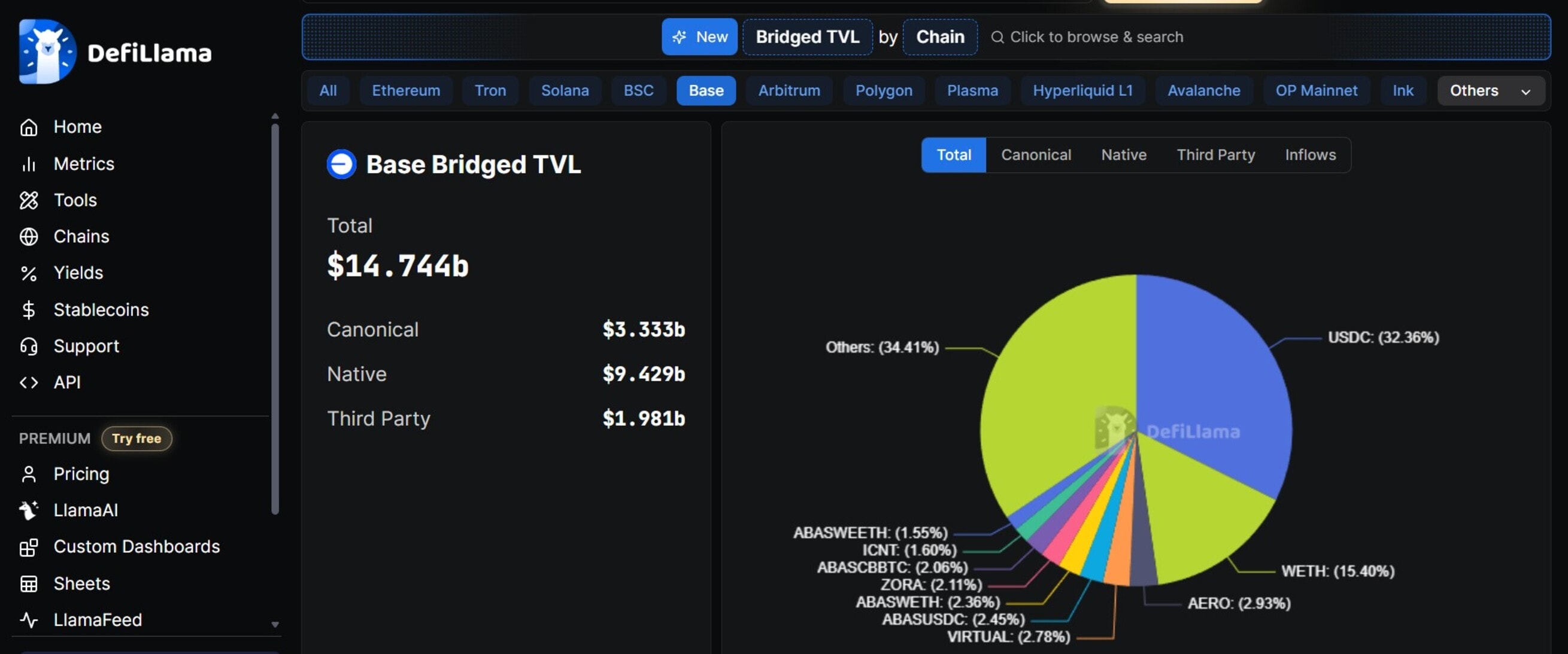
Now, this steady flow of capital carries implications beyond decentralized finance (DeFi) alone. Bridged assets support liquidity for gaming economies, NFT marketplaces, and on-chain social applications. In this context, capital inflows represent real economic commitment: users are not merely testing Base, but actively building, trading, and participating within its ecosystem.
User Activity, Transaction Volumes, & Active Wallets
One of the clearest ways to determine growth and organic adoption levels for a blockchain project is on-chain activity. Base’s growth across wallets, transactions, and daily engagement shows how quickly the network has scaled in real usage terms. Rather than relying on isolated spikes, Base’s metrics point to sustained and broad participation.
Active wallet growth has increased, with millions of active users and year-over-year growth exceeding 1,280%. This expansion consistently interacts with applications across DeFi, gaming, and NFTs. The presence of millions of monthly active users suggests that the Base blockchain has achieved recurring engagement rather than episodic traffic driven by incentives or short-lived campaigns.
Transaction activity further strengthens these numbers. Annual data shows nearly 9.87 million transactions recorded in 2025, representing a growth of more than 2,000%. As the ecosystem matured, monthly transaction volumes expanded from hundreds of thousands to over 100 million by early 2026.
At peak periods, daily transaction counts have reportedly exceeded 15 million, often coinciding with ecosystem events, application launches, or surges in gaming and NFT activity. Relative to other Layer-2 networks, Base frequently ranks at the top of on-chain leaderboards for volume and wallet activity, sometimes surpassing the Ethereum gaming ecosystem.
Top Gaming Projects on Base Blockchain
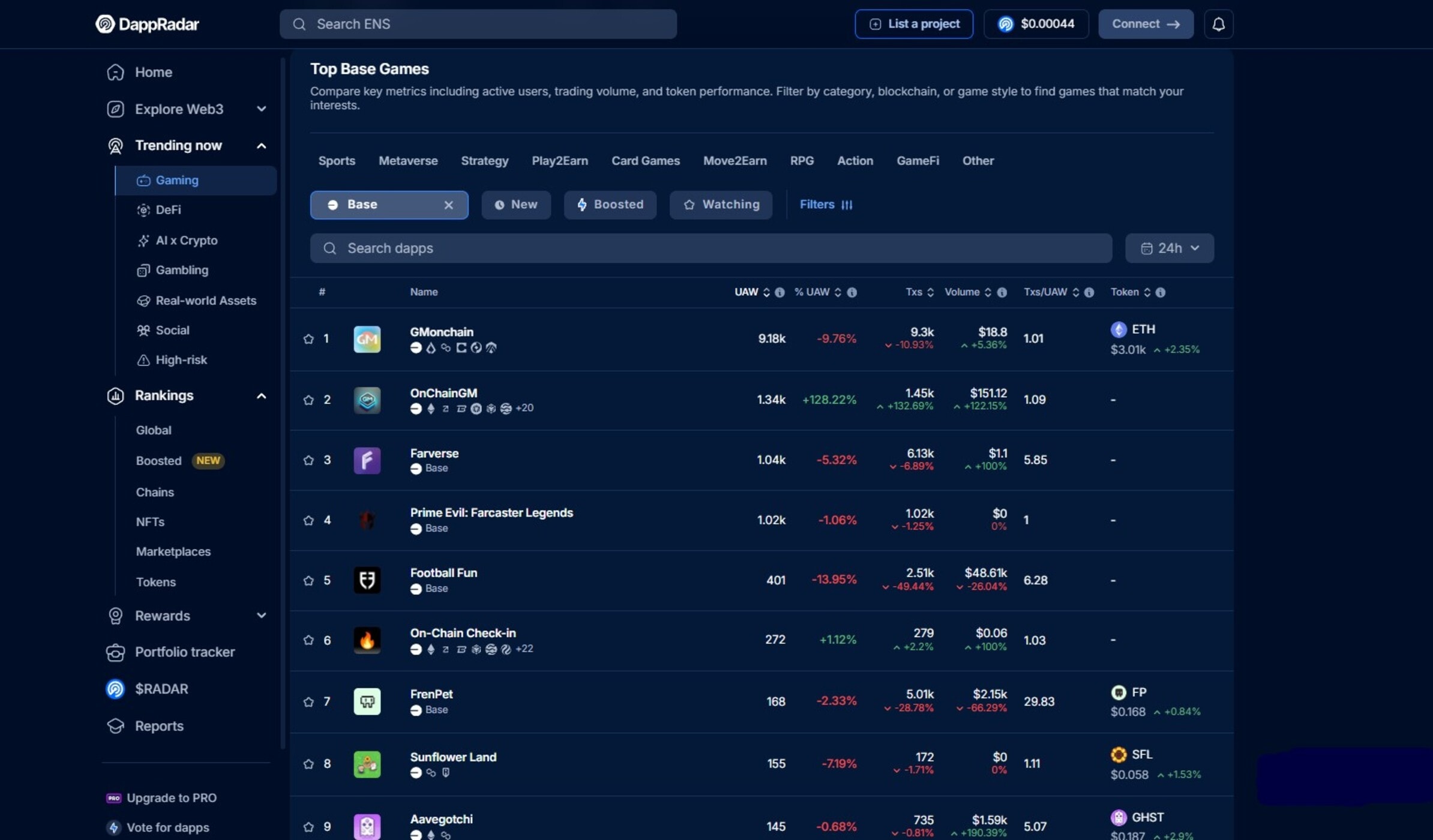
The leading projects on the Base network are GMonchain, Farverse, OnChainGM, Anome, Football Fun, while top NFT games on the chain include Base Moonpepe, Basert De Niro says HUH, Base Xman, and Basezilla.
These games show how developers are experimenting with accessibility, composability, and user-owned progression rather than pursuing traditional high-fidelity blockchain games.
For instance, lightweight engagement games such as GMonchain prioritize short interaction loops and social participation. GMonchain currently has about 4.64k Unique Active Wallets (UAW) interacting with the Base network.
More immersive experiences like Farverse take a different approach by anchoring progression and world state directly on-chain. While Farverse attracts fewer users than lighter games (currently at 1.12k UAW daily), its on-chain metrics show higher average transactions per wallet and more persistent engagement with over 4,000 onchain players.
Meanwhile, games like Anome and Football Fun show how niche narratives and real-world themes can find traction within the ecosystem.
On the NFT gaming side, collections such as Basert De Niro says HUH, Base Xman, and Basezilla play to reinforce identity and ownership within the ecosystem. Rather than functioning purely as speculative assets, these NFT-based games and collections sustain activity through ongoing minting, secondary-market trading, and repeated wallet interactions.
Top NFT Projects and Marketplaces on Base Chain
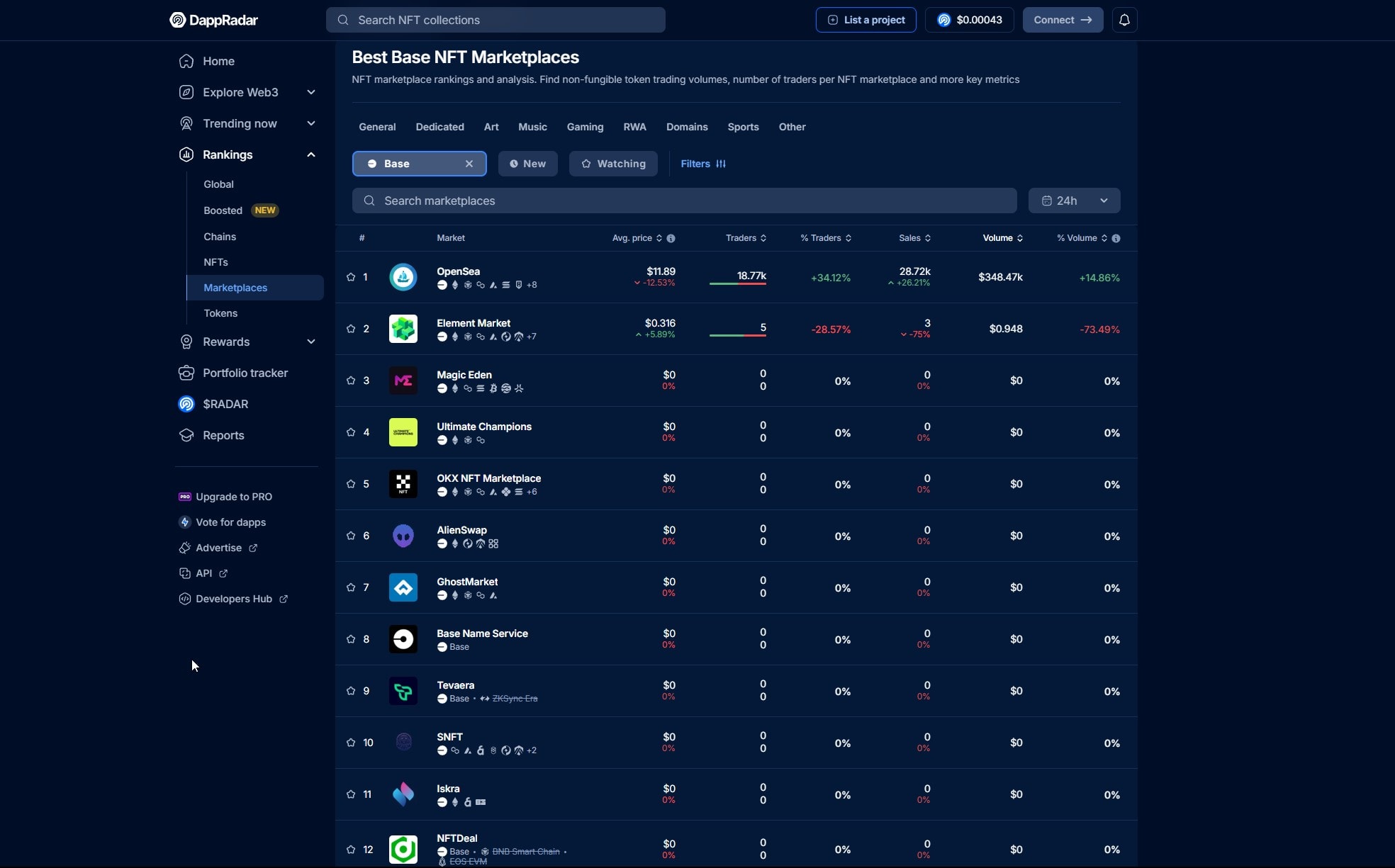
Top NFT Marketplaces on Base include OpenSea, OKX NFT Marketplace, SNFT, Element Market, Magic Eden, AlienSwap, GhostMarket, Iskra, and Ultimate Champions. OpenSea is the top marketplace on Base, offering a broad NFT variety, user-friendly minting, and high liquidity with over $3.1 million in transactions and an average of 35k daily active users (UAW).
Following OpenSea is Element Market. It is the first community-driven aggregated marketplace and is one of the highest drivers of liquidity and user engagement to the Base Network. It currently has nearly $600k in transaction volume and about 42 daily UAW at the time of writing.
These projects, alongside others, shape the network’s NFT economy by acting as liquidity gateways, discovery layers, and transaction engines affecting user onboarding and capital circulation across the Base ecosystem.
Moving on, popular NFT projects on Base feature collections like Wrapped ANFE Base, DX Terminal, Onchain Gaias, Based Punks, BasedFellas, and Lil Bangers. Base does not currently support any AAA-level web3 game; however, the activity on these games shows how attention and liquidity drive adoption.
For instance, DX Terminal alone drives about 200k in volume with over 16,000 unique users trading. Meanwhile, other games like the Warplets and Get Based – Primitive Edition are also topping the charts, with daily volumes of over $18,000 and $6,000, respectively.
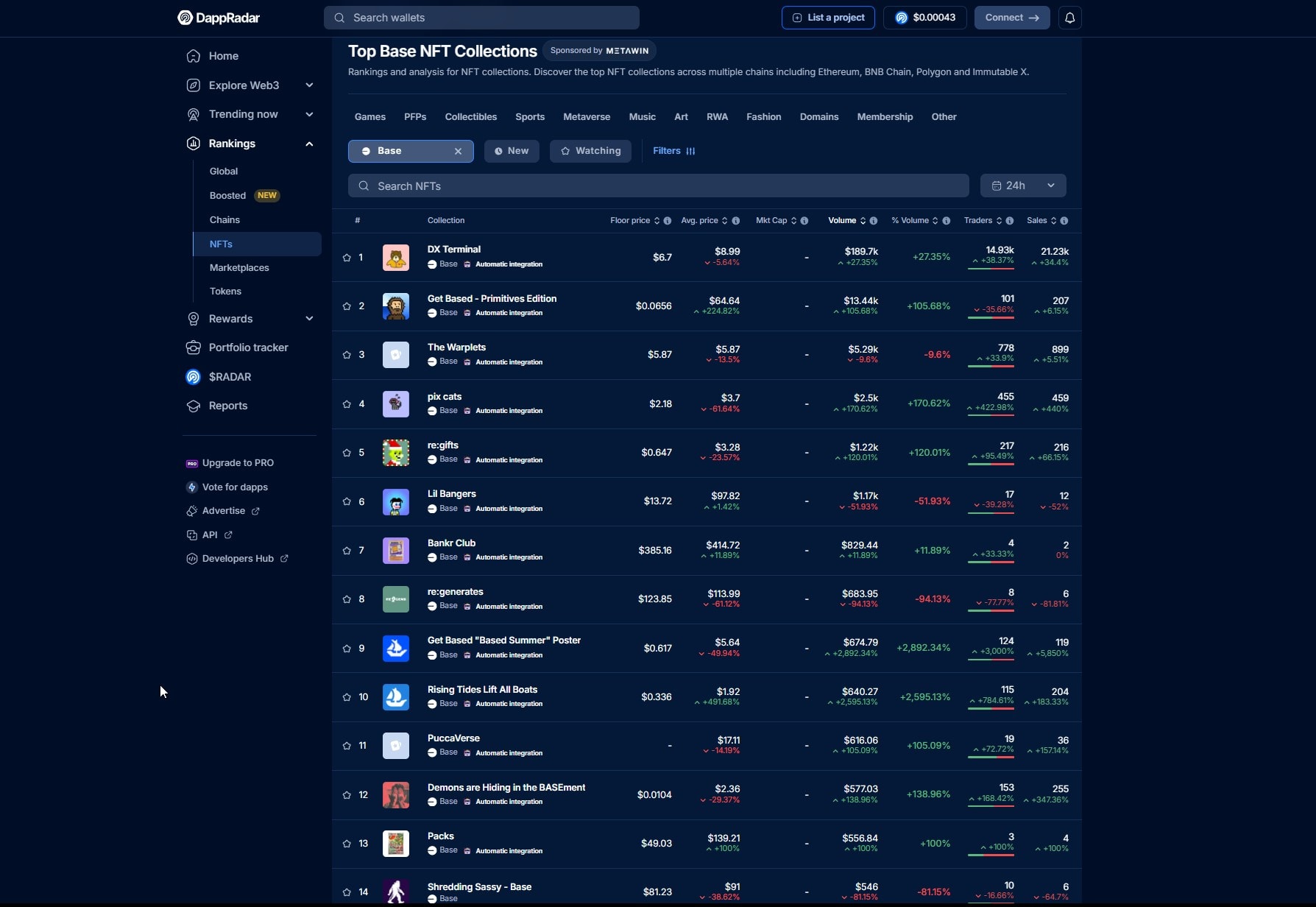
While many high-value collections still originate on Ethereum or other chains, the trading metrics of these games show how liquidity and attention now distribute across networks more fluidly. For Base, this translates into sustained transactional relevance even when flagship collections remain multi-chain or Ethereum-first.
Base’s Growing GameFi Ecosystem – Key Projects and Innovation
Base is a leading Ethereum Layer 2 network optimized for low-cost, high-speed transactions. It is steadily positioning itself as a strong foundation for GameFi and NFT applications by combining Ethereum L2 features and access to deep liquidity of over $86.6 million in all-time volume, thanks to Coinbase’s deep wallet support.
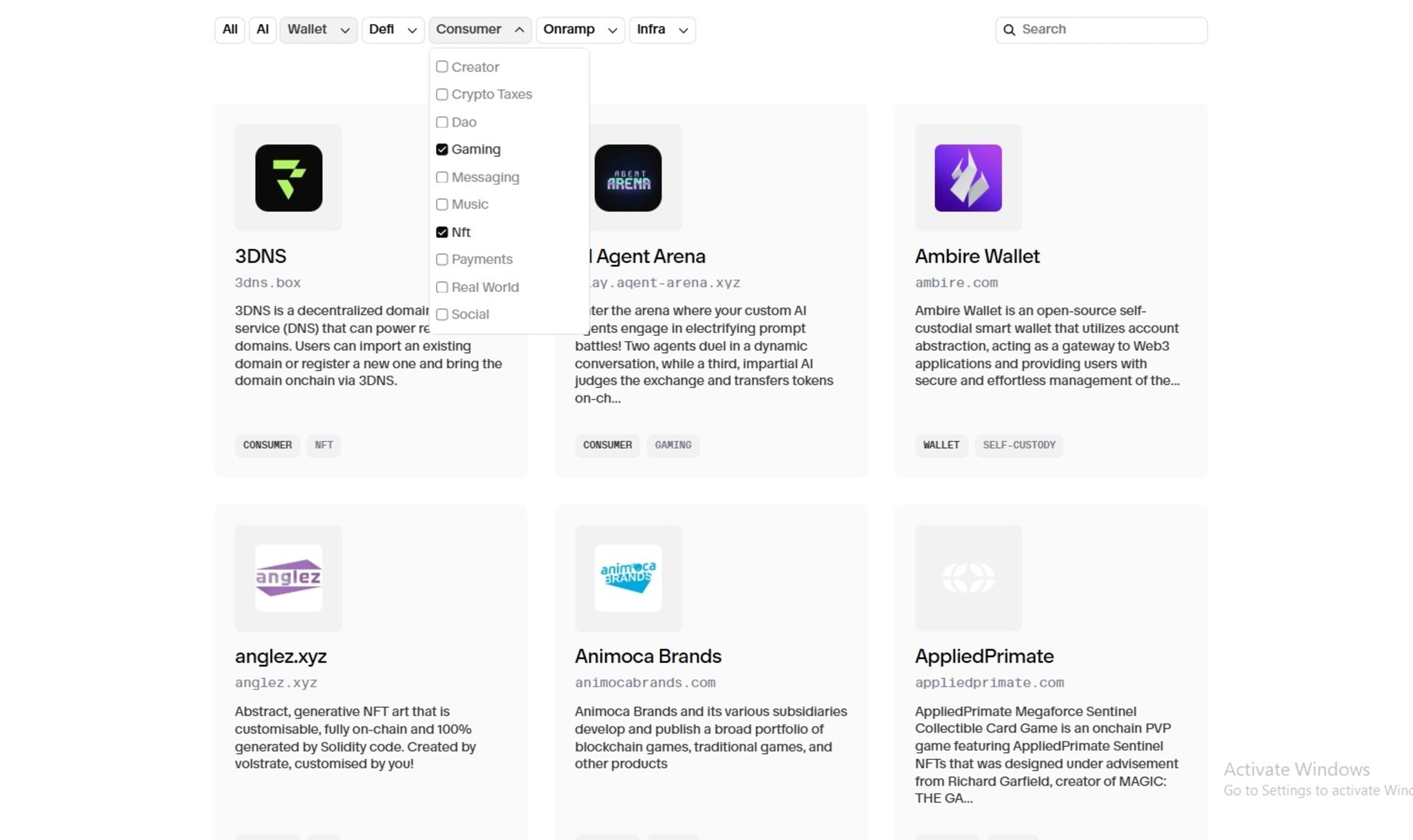
On the Base GameFi side, Base is seeing growing experimentation around fully onchain and hybrid games. Instead of focusing on AAA-scale games, Base hosts innovative GameFi titles focused on addictive, fully on-chain mechanics. Some of these GameFi projects include:
- Parallel Colony: An extension of the Parallel ecosystem, this onchain strategy game leverages NFTs for characters, land, and resources, demonstrating how complex game logic and asset ownership can operate efficiently on Base.
- Ultimate Champions: A fantasy sports GameFi project that uses licensed digital player cards as NFTs, blending familiar gaming mechanics with blockchain-based ownership and tradable assets.
- PerionXP (Cutthroat Chaos): Perion’s Web3 gaming initiative includes Cutthroat Chaos, a meta-layer gaming experience with significant onchain activity. PerionXP enables players to compete for crypto rewards through quests and gameplay, including deep integration on Base.
- Based Punks–Inspired Game Experiments: Several community-driven and experimental games are being built around Base-native NFT collections, using existing NFTs as playable characters or in-game identities.
- FrenPet: A pet-raising and battling blockchain game on Base that taps into nostalgia with a play-to-earn twist. Players adopt, feed, train, and battle digital pets, earn points, and can win rewards based on performance. Its gameplay involves feeding pets, PvP battles, daily quests, and rewards in ETH or $FP tokens, alongside a thriving secondary market on NFT platforms like OpenSea.
In addition to these titles, Base has become a testing ground for lightweight, fully onchain games that rely on frequent transactions, something that would be impractical on higher-fee networks.
NFT & Developer Infrastructure Powering GameFi on Base
From an infrastructure perspective, Base supports the core building blocks required for scalable Base GameFi applications. Smart contracts handle asset ownership, in-game logic, and reward distribution, while off-chain components such as game engines, indexers, and data availability layers help maintain performance and responsiveness.
Other core components of the Base infrastructure include the following:
- NFT Marketplaces: Base hosts some of the best NFT marketplaces and platforms, such as OpenSea, Magic Eden, Element Market, and OKX NFT Marketplace. These platforms provide liquidity, discovery, and secondary markets for gaming and collectible NFTs.
- NFT Standards: ERC-721 is commonly used for unique game assets like characters and land, while ERC-1155 enables semi-fungible items such as weapons, power-ups, and in-game resources.
- Wallet Infrastructure: Coinbase Wallet and other EVM-compatible wallets simplify player authentication, asset storage, and in-game transactions.
- Indexing and Data Tools: Off-chain indexers and analytics tools help games track player actions, NFT ownership, and in-game events without compromising performance.
- Composable DeFi Primitives: Game assets can integrate with DeFi features such as staking, liquidity pools, or lending, allowing NFTs to generate yield or unlock new gameplay dynamics.
For developers, Base lowers the cost and complexity of building GameFi and NFT applications. Low gas fees make high-frequency in-game actions viable, while EVM compatibility allows teams to reuse existing Ethereum tooling and smart contracts.
After building, game developers benefit from strong marketplace support, which ensures immediate liquidity for game assets. Additionally, Coinbase’s distribution layer improves visibility and onboarding for mainstream users, which in turn boosts adoption.
Best Upcoming Projects on Base Network in 2026
Upcoming projects on the Base network cut across decentralized finance (DeFi), socialFi, prediction markets, AI agents, and RWAs, many backed by Coinbase Ventures. This backing positions them for potential token launches and airdrops amid Base’s anticipated native token debut.
Top upcoming DeFi projects
Aerodrome leads as Base’s premier decentralized exchange (DEX) with daily spot volumes over $560 million, offering efficient liquidity and incentives for traders. Morpho, a lending protocol, manages $12.6 billion in deposits, ranking just behind Aave and Sky through optimized lending markets. Meanwhile, Grand Base introduces synthetic RWAs for spot trading, enabling tokenized exposure to real-world assets with deep liquidity.
Social and creator platforms
On social and creator platforms, Zora is at the top of on-chain social networking, enabling creators to tokenize posts as NFTs or other digital assets. This project is backed by its Believe Fund, which is deploying 20 million ZORA tokens and integrating with the Base App. The tools support live streaming and one-click tokenization, attracting Coinbase Ventures funding across rounds.
Prediction and AI innovations
When it comes to prediction markets, Limitless dominates the decentralized space with $520 million in trading volume and dual Coinbase Ventures investments, ideal for event-based betting. For innovations in AI, Bankr pioneers AI agents via the x402 protocol, integrated into Base App and funded by the Base Ecosystem Fund for automated workflows.
In all these, the trends for 2026 are beginning with Coinbase Ventures’ excitement for RWA perpetuals, next-gen DeFi, and AI integrations on Base. These innovative solutions align with app ideas like smart contract marketplaces and NFT gaming drops such as BytePepe or Based Auras.
Why Developers Choose Base for Building Games and NFTs
Here is a rundown of some of the notable reasons game developers use Base to build.
- Scalability: Base handles high transaction volumes essential for multiplayer games and NFT marketplaces, ensuring lag-free gameplay during peak times. Its optimistic rollup design processes thousands of transactions per second, far surpassing Ethereum mainnet limitations for dynamic virtual worlds.
- Cost Efficiency: Transaction fees on Base remain under $0.01 even under load, making frequent in-game actions like asset trades or NFT mints affordable for players worldwide. This contrasts exceedingly with congested networks, preserving player budgets and encouraging broader adoption.
- NFT and Asset Ownership: True ownership of in-game items as NFTs thrives on Base, with frictionless minting, trading, and interoperability across games. Game builders leverage this for player-driven economies, where digital assets hold real value beyond single titles.
- Developer-Friendly Tools: Coinbase provides grants, SDKs, and ecosystem funds that ease onboarding, from smart contract deployment to cross-platform compatibility. Security features and EVM equivalence allow rapid porting of Ethereum tools, accelerating game launches.
The Future of Gaming and NFTs on Base
The future of gaming and NFTs on Base Network looks promising, driven by its low-cost scalability, which fosters immersive player-owned economies. Projects will leverage optimistic rollups for seamless real-time interactions, with NFT utilities evolving into core gameplay assets.
Base aims to push throughput beyond 1 Ggas/s through client upgrades like Reth and higher gas limits, supporting massive multiplayer sessions without lag or high gas fees. This enables complex games with billions of transactions, as seen in pilots like Blocklords, which handles 80 million transactions across 1.8 million wallets.
NFTs on Base will emphasize interoperability and utility, allowing true cross-game asset ownership via EVM standards and Coinbase tools for frictionless minting/trading. Expect play-to-own models where items gain value through usage, backed by ecosystem funds for creator grants.
Looking ahead, AI-driven agents and RWAs will integrate into games, creating dynamic worlds with tokenized real-world ties, while socialFi elements boost community governance. Base’s consumer focus positions it to capture Web3 gaming growth, targeting sustainable tokenomics over hype.
Conclusion
Base Network stands out as a leading Ethereum Layer 2 for gaming and NFTs due to its optimistic rollup scalability, low fees, and Coinbase-backed tools. While the network is relatively new compared to other top chains and does not currently list AAA-scale games, the numbers show growing interest, and the future holds significant technological advancements in the future.
FAQs
The best NFT marketplace on Base by trading volume and sales is OpenSea. In addition to OpenSea, some of the best nft projects on Base include Magic Eden, Element Market, Ultimate Champions, and OKX NFT Marketplace, which offer specialized blockchain features, including low fees, a specific gaming focus, strong sales and volume, and multi-chain support.
No. There are no AAA games (high-budget titles from major studios like EA, Ubisoft, or Activision) currently built on the Base blockchain. Base primarily supports lightweight blockchain games and gaming primitives, such as NFT-based assets or casual play-to-earn experiences, but lacks the infrastructure for full-scale AAA development that requires massive compute or custom engines.
No, Base is not better than Polygon and Arbitrum for games. When comparing these three chains, Polygon leads for blockchain games due to its mature ecosystem, with established titles like those on Immutable X, and its high throughput for in-game transactions. The Arbitrum gaming ecosystem follows closely, with strong gaming support via Orbit chains and low-latency features, while Base lacks an advantage in AAA-grade games and adoption.
Yes, you can bridge NFTs from other chains to Base using cross-chain bridges that support ERC-721 standards and Base’s EVM compatibility. Several protocols, such as RocketX, Portal Token Bridge, and general cross-chain solutions, simplify bridging from Ethereum, Polygon, Arbitrum, and other chains to Base in minutes.
To buy and store NFTs on Base, you first need a compatible wallet such as Coinbase Wallet or MetaMask and some ETH bridged to the Base network. Connect your wallet to a supported marketplace like OpenSea or Magic Eden, choose an NFT, and complete the purchase. Your NFTs will automatically appear in your wallet under the Base network.