

Bitcoin price prediction is at the center of every serious crypto investor’s strategy as 2026 approaches. With market cycles tightening, institutional adoption expanding, and regulation becoming clearer worldwide, the next major move could redefine long term portfolios. While the current bitcoin price reflects today’s sentiment, it does not fully capture the technological upgrades, macroeconomic shifts, and supply dynamics building behind the scenes.
Will Bitcoin break into a new all time high, stabilize as digital gold, or face another correction before climbing higher? In this forecast, we analyze market data driven trends, expert projections, and key indicators that could shape BTC’s path in 2026. If you want clarity instead of hype, keep reading.
Bitcoin (BTC) Overview
Bitcoin (BTC) is the pioneering cryptocurrency that launched the entire digital asset movement and remains the most traded and widely recognized crypto in the world. It operates on a decentralized blockchain where transactions are verified by a global network of computers rather than a central authority. Bitcoin’s design limits total supply to 21 million coins, giving it scarcity that many investors view as digital gold and a potential hedge against inflation. Its future price projections are based on a combination of market sentiment, historical data, and user-generated forecasts, reflecting both bullish and bearish outlooks for the years ahead.
BTC Market Snapshot
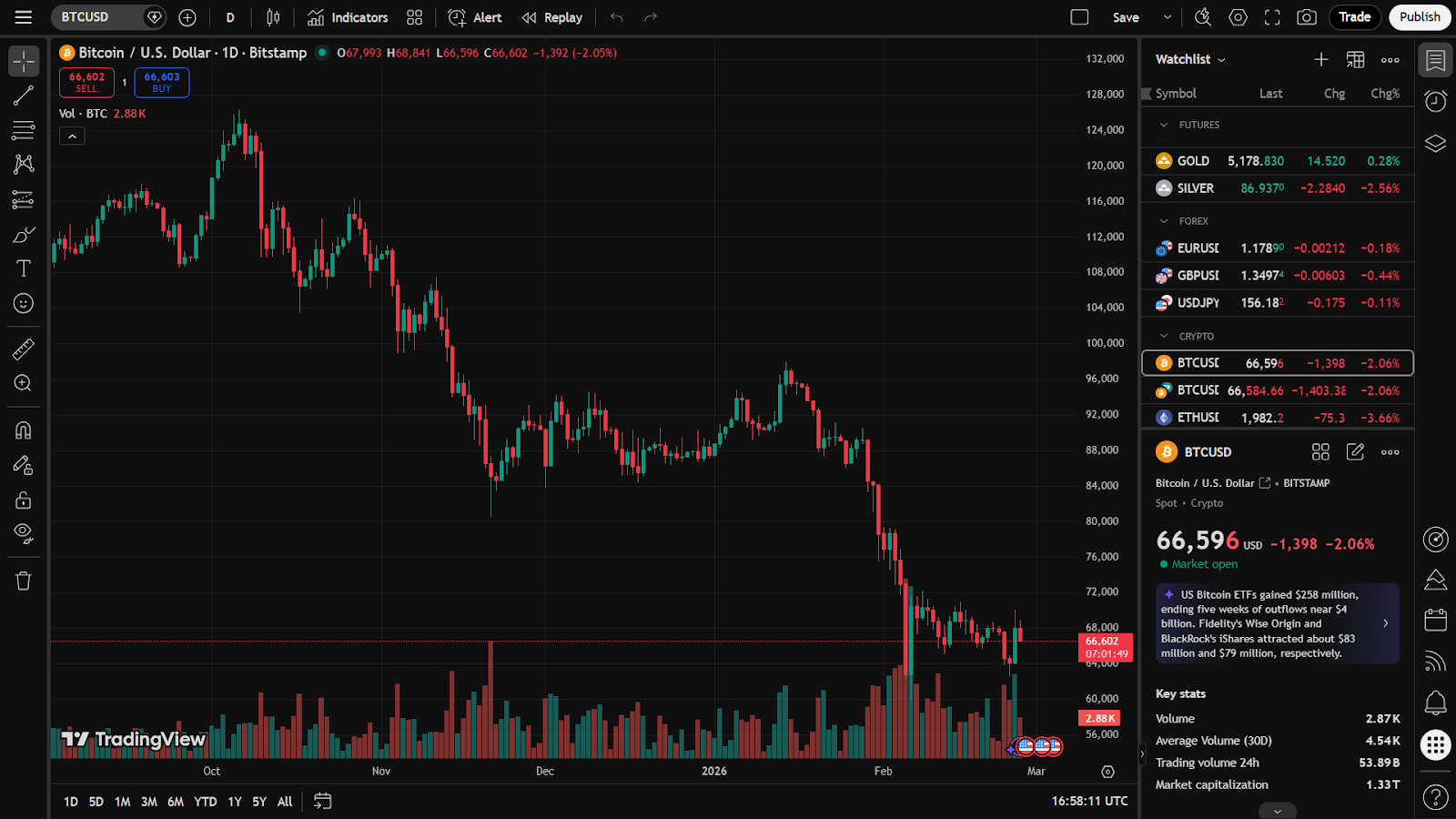
Right now, Bitcoin is trading near the current Bitcoin price of roughly $60,000 to $65,000 across major exchanges, with a market cap fluctuating around the trillion-dollar mark, reinforcing its position as the largest cryptocurrency by valuation. Daily trading volume often ranges between $20 billion and $35 billion, reflecting deep liquidity and strong participation from both retail and institutional investors. Short term price action remains sensitive to macroeconomic data, ETF flows, and regulatory headlines.
Market sentiment around BTC is typically mixed but reactive, swinging between bullish optimism during rallies and caution during corrections. Recent price forecast models suggest a gradual long term upside driven by limited supply and growing adoption, though volatility remains a defining characteristic. Compared to its previous all time high, Bitcoin continues to trade below peak levels, leaving room for both recovery narratives and downside risks depending on broader market conditions.
BTC Price History and Performance
Bitcoin launched in 2009 as a peer to peer digital currency and gradually evolved into the benchmark asset of the cryptocurrency market. Over time, it has moved through distinct expansion and contraction phases, shaping broader crypto market sentiment and setting the tone for the entire industry.
- Early Growth Phase: Between 2013 and 2017, BTC climbed from under $1,000 to nearly $20,000 before entering a prolonged correction. These cycles were defined by rapid rallies, sharp pullbacks, and significant price volatility as adoption was still developing.
- Understand Bitcoin Halving: The programmed supply cut that occurs roughly every four years has historically influenced long term trajectory. By reducing the rate of new coin issuance, halvings in 2012, 2016, and 2020 preceded major upward cycles, even though short term reactions were often mixed.
- Major Turning Points: The 2020 to 2021 rally pushed Bitcoin to record highs near $69,000, driven by institutional participation and macroeconomic shifts. Subsequent corrections reinforced BTC’s cyclical market structure while maintaining higher long term support levels.
- Track Record: Despite repeated downturns, Bitcoin has consistently recovered over multi-year periods, reinforcing its position as a high risk yet historically appreciating asset within digital finance.
Bitcoin (BTC) Technical Analysis
Bitcoin’s technical outlook reflects a structurally bullish asset that continues to trade within established long term support and resistance zones while reacting sharply to short term catalysts. Key indicators such as the 50-day and 200-day moving averages, RSI levels, and trading volume help traders gauge momentum shifts and broader global sentiment. If you are mining Bitcoin as an investor, understanding these technical signals can help you better time accumulation and hedge risk.
Moving Averages
Bitcoin’s short term moving averages are currently tracking close to spot price, while the 200-day moving average remains a major trend gauge for long term direction. When BTC trades above its 200-day average, broader structure typically favors bullish continuation, reflecting stronger market sentiment. A confirmed golden cross, where the 50-day crosses above the 200-day, has historically preceded extended upside phases, while a death cross often signals consolidation or downside pressure.
Relative Strength Index (RSI)
The Relative Strength Index (RSI) for Bitcoin generally fluctuates between 40 and 60 during consolidation phases, signaling balanced momentum rather than extreme conditions. Readings above 70 tend to indicate overheated conditions, while dips below 30 suggest oversold territory that may attract buyers. Recent RSI positioning reflects neutral momentum, aligning with range-bound price action rather than an aggressive breakout.
Key Price Levels
- Speculative range: $60,000 – $70,000. This zone has contained much of Bitcoin’s recent movement, with traders watching closely for expansion beyond this corridor.
- Inflection point: $65,000. Sustained acceptance above this level could strengthen bullish conviction, while rejection may invite short term pullbacks.
- Prevailing resistance: $72,000 – $75,000. A decisive move above this region with strong volume could open the path toward retesting prior all time highs.
Support Levels
| Support Level | Price (USD) |
| S1 | $60,000 |
| S2 | $55,000 |
| S3 | $50,000 |
| S4 | $45,000 |
| S5 | $40,000 |
Resistance Levels
| Resistance Level | Price (USD) |
| R1 | $72,000 |
| R2 | $75,000 |
| R3 | $80,000 |
| R4 | $85,000 |
| R5 | $90,000 |
BTC Price Prediction 2027
| Month | Minimum Price (USD) | Average Price (USD) | Maximum Price (USD) | Expected ROI (%) |
| Jan 2027 | $106,588 | $126,144 | $145,700 | +113% |
| Feb 2027 | $108,246 | $127,802 | $147,358 | +115% |
| Mar 2027 | $109,904 | $129,460 | $149,016 | +118% |
| Apr 2027 | $111,563 | $131,118 | $150,674 | +120% |
| May 2027 | $113,221 | $132,777 | $152,332 | +123% |
| Jun 2027 | $114,879 | $134,435 | $153,991 | +125% |
| Jul 2027 | $116,537 | $136,093 | $155,649 | +127% |
| Aug 2027 | $118,195 | $137,751 | $157,307 | +130% |
| Sep 2027 | $119,853 | $139,409 | $158,965 | +133% |
| Oct 2027 | $121,512 | $141,067 | $160,623 | +135% |
| Nov 2027 | $123,170 | $142,726 | $162,281 | +138% |
| Dec 2027 | $124,828 | $144,384 | $163,940 | +140% |
BTC Price Prediction 2028
| Month | Minimum Price (USD) | Average Price (USD) | Maximum Price (USD) | Expected ROI (%) |
| Jan 2028 | $126,140 | $145,731 | $165,322 | +154% |
| Feb 2028 | $127,790 | $147,381 | $166,972 | +156% |
| Mar 2028 | $129,440 | $149,031 | $168,622 | +159% |
| Apr 2028 | $131,091 | $150,682 | $170,273 | +162% |
| May 2028 | $132,741 | $152,332 | $171,923 | +164% |
| Jun 2028 | $134,391 | $153,982 | $173,573 | +167% |
| Jul 2028 | $136,041 | $155,632 | $175,223 | +169% |
| Aug 2028 | $137,692 | $157,283 | $176,874 | +172% |
| Sep 2028 | $139,342 | $158,933 | $178,524 | +174% |
| Oct 2028 | $140,992 | $160,583 | $180,174 | +177% |
| Nov 2028 | $142,643 | $162,234 | $181,825 | +179% |
| Dec 2028 | $144,293 | $163,884 | $183,475 | +182% |
Long-term Outlook: BTC Price Prediction (2026–2030)
| Year | Minimum Price (USD) | Average Price (USD) | Maximum Price (USD) |
| 2026 | $60,000 | $105,000 | $150,000 |
| 2027 | $70,000 | $115,000 | $200,000 |
| 2028 | $85,000 | $120,000 | $200,000 |
| 2029 | $110,000 | $150,000 | $300,000 |
| 2030 | $140,000 | $185,000 | $400,000 |
What Factors Influence Bitcoin’s Price?
Bitcoin’s valuation is never driven by a single catalyst. There aremultiple forces interacting at once, shaping market direction and influencing every short and long term price forecast. Here are the factors influencing Bitcoin’s price:
Supply and Scarcity
Bitcoin has a fixed cap of 21 million coins, which makes knowing the bitcoins that are available key when assessing long term value. Halving events reduce new supply issuance, tightening circulation, and historically contribute to upward price cycles when demand remains strong.
Market Demand and Adoption
Institutional investment, ETF inflows, corporate treasury allocations, and retail participation all directly impact demand. When adoption accelerates, increased buying pressure can push bitcoin into new Bitcoin trading ranges.
Market Sentiment and Media Influence
Investor psychology plays a powerful role in short term movements. Positive headlines, macro optimism, and bullish technical signals can fuel rallies, while fear and uncertainty often amplify selloffs.
Macroeconomic Conditions
Interest rates, inflation trends, and global liquidity conditions significantly affect risk assets. In periods of monetary easing, capital often flows into alternative assets like Bitcoin.
Regulation and Policy Developments
Government decisions regarding crypto taxation, exchange oversight, and Bitcoin ETF approvals can rapidly shift expectations. Clear and supportive regulation tends to strengthen confidence, while restrictive policies may temporarily suppress momentum.
Key Risks That Could Impact BTC’s Forecast
Despite strong long term projections, several risk factors could alter Bitcoin’s expected trajectory and reshape any price forecast. The following are the risks that could impact BTC’s forecast:
- Regulatory uncertainty in major economies could restrict trading activity, impact institutional participation, or limit exchange operations.
- Extreme price volatility remains one of Bitcoin’s defining characteristics, with rapid swings capable of triggering liquidations and sharp sentiment shifts.
- Macroeconomic shocks such as aggressive rate hikes, liquidity tightening, or global recession fears could reduce capital flows into digital assets.
- Security vulnerabilities, exchange collapses, or large-scale hacks may weaken trust and disrupt short term momentum.
- The process of buying a bitcoin can still present technical and compliance barriers for new users, potentially slowing mainstream adoption if accessibility does not improve.
Final Thoughts
Bitcoin remains a high-potential yet high-risk asset shaped by adoption trends, macroeconomic forces, and evolving regulation. While long term projections suggest continued growth, short term price volatility can significantly impact entry and exit timing. Investors should evaluate market conditions, risk tolerance, and broader portfolio strategy before acting on any price forecast. A balanced approach that combines research, technical awareness, and disciplined risk management is essential when navigating Bitcoin’s future trajectory.
FAQs
Bitcoin is expected by many long term forecasts to potentially surpass $100,000 before or by 2030, depending on adoption growth, institutional demand, and macroeconomic stability.
Bitcoin is considered a strong long term investment by supporters due to its fixed supply and historical growth, though it carries substantial price volatility and risk.
Bitcoin is projected in 2026 forecasts to trade within a broad range, with bullish models pointing to six figure potential while conservative estimates suggest moderate growth.
Bitcoin may be attractive during consolidation phases, but timing the market is difficult, so many investors prefer gradual accumulation rather than waiting for perfect dips.
Bitcoin halving reduces new supply entering circulation, and historically, this supply shock has preceded upward price cycles over the following months.
Bitcoin has historically moved in cycles that align closely with its four-year next halving schedule, although future performance may vary as the market matures.