
Disclaimer: This article is for informational purposes only and does not constitute financial advice. BitPinas has no commercial relationship with any mentioned entity unless otherwise stated.
📬 Get the biggest crypto stories in the Philippines and Southeast Asia every week — subscribe to the BitPinas Newsletter.
This article is part of our Consensus HK 2026 Coverage
For over a decade, the narrative around Bitcoin has shifted from “peer-to-peer electronic cash” to “digital gold”, a store of value meant to be held, not spent. While this secured Bitcoin’s place in institutional portfolios, it left a gap for a true transactional currency with a vibrant culture.
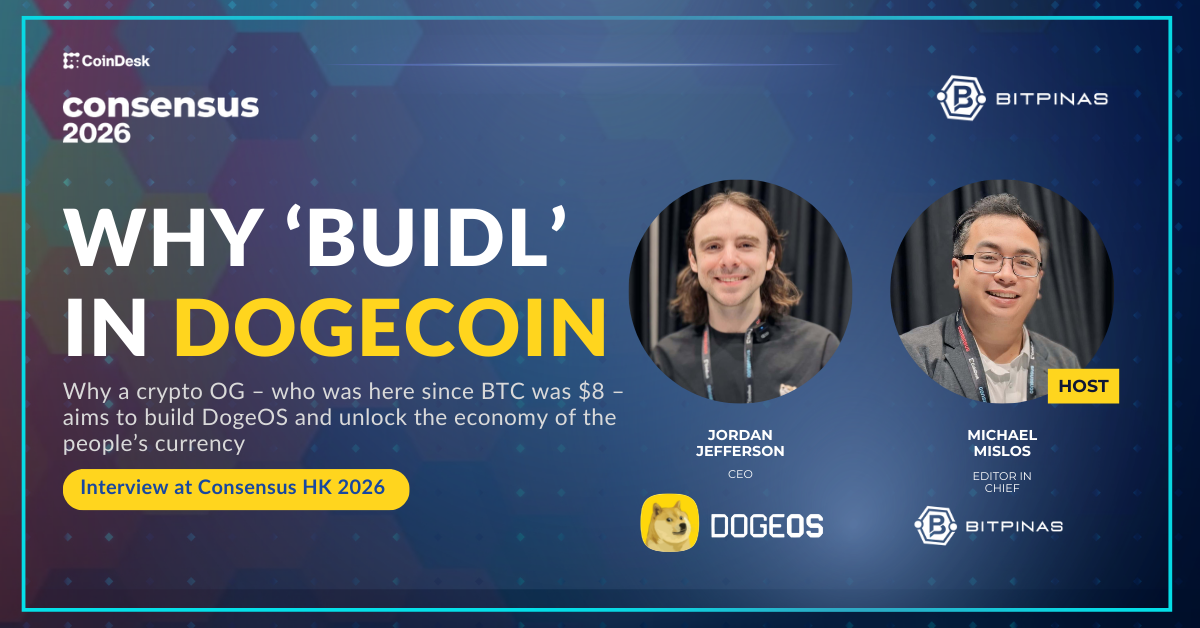
Jordan Jefferson (X), a developer who has been building in the crypto space since Bitcoin traded at just $8, watched this evolution firsthand. Now, as the Founder of DogeOS, find out in this interview why he is actively building the infrastructure to turn the world’s most famous meme coin into a functional economy.
Jordan Jefferson’s Vision: DogeOS

“The Dogecoin community was really carrying the torch of that original vision [of Bitcoin],” Jordan shared in an interview with BitPinas at Consensus Hong Kong:
“I finally appreciated what the real value of culture was, the value of community… The Dogecoin community has been here, believing in the same ethos, attracting the same type of people for over a decade now.”
For Jordan, the “joke” of Dogecoin is actually its greatest strength, and he’s building the tech to ensure the “People’s Currency” finally benefits the people holding it.
From Early Bitcoin Believer to Dogecoin Builder
Jordan’s history in crypto runs deeper than most.
He entered the space when the “industry” was barely a concept… when there were almost no conferences, no meetups, but just a few guys building in obscurity:
“I was just one guy who was building, knew a few other guys who were building… but it definitely didn’t feel like it does now. I was skeptical, but they sort of convinced me: ‘Look, the potential here is limitless. This could change the world.’”
While he was an early convert to Bitcoin, he admitted he didn’t initially “get” Dogecoin. Like many, he dismissed it as a funny meme. But as he watched the community form, he noticed something familiar: the same raw, grassroots energy that powered early Bitcoin:
“It felt like the early Bitcoin days. It felt like people really believed in the core premise of cryptocurrency, which is actually using it as money and actually sending it.”
The Pivot: Building What Doge Was Missing

Four years ago, Jordan decided to stop watching and start building. He launched a dedicated Dogecoin wallet, simply because one with modern features didn’t exist. The response was immediate and overwhelming, but he quickly hit a ceiling.
The community wanted social features, games, and finance, but the Dogecoin blockchain wasn’t built for complex applications.
“We got to the point where there were so many things we wanted to build… but there wasn’t really a way to build them on Dogecoin and still be decentralized.”
Refusing to build a centralized custodial solution, he set out to solve the infrastructure problem. The result is DogeOS, which runs on top of Dogecoin, using DOGE for gas.
Unlocking the Economy of the ‘People’s Currency’
The core problem DogeOS aims to solve is value capture. Currently, Dogecoin is one of the most traded cryptocurrencies in the world, yet its holders have almost no way to use it beyond basic transfers, says Jordan:
“There is no DeFi in Dogecoin… there’s no staking, there’s no opportunities to borrow and lend against your Doge in a trustless way. Instead, you use exchanges.”
The consequence? Centralized exchanges capture billions of dollars in trading fees, while the community gets nothing.
“We call Dogecoin the people’s currency, [but] the people are not benefiting from this,” he argued:
“You look at the Ethereum community, Solana community. The people there are able to benefit and profit from the activity of the ecosystem. So we wanna let them capture that value.”
Real-World Adoption in the Philippines
Jordan has seen Dogecoin work as actual money, particularly in the Philippines. When his team launched their wallet without any marketing, they noticed significant organic activity from the region, so he doesn’t see his vision as something that’s just theoretical. It’s actually happening:
“We saw night market vendors buying and selling using our wallet and transacting in Dogecoin… We saw remittances, which obviously is a huge industry in the Philippines. These were kind of the reasons that crypto originally existed.”
He sees the Philippines as a key market, not just for trading, but for the “fun” side of the ecosystem, including mobile gaming and social apps built on DogeOS.
“I love going to markets and meeting users where there are people who have used it as money… that’s something that excites me about the Philippines.”
Jordan Jefferson
2026: The Year of the Doge?
As DogeOS prepares for its full mainnet launch in the coming months, Jordan believes the ecosystem is on the verge of a massive leap forward. The goal is to transfer economic activity back on-chain and not to pump the price.
“We have the first taste of Doge DeFi… and real earning opportunities coming very, very soon,” he teased.
For Jordan, the future of Dogecoin is about finally giving its massive community the tools to build, play, and earn:
“I think 2026, we’re saying it’s the Year of the Doge. It’s about opportunity, the ecosystem, and really transferring some economic activity and wealth on-chain, and then back into the hands of the people.”
Jordan Jefferson
This article is published on BitPinas: From $8 Bitcoin to DogeOS: Why an Early Crypto Adopter is Betting Big on the ‘People’s Currency’
What else is happening in Crypto Philippines and beyond?