Key Takeaways
- Rep. Begich introduced ARMA to buy 1M Bitcoin, shifting market policy before Congress sets future crypto laws.
- Funding the reserve via gold, the US Treasury would buy 200K BTC yearly, securing crypto property rights.
- Following a March 2025 EO, ARMA stabilizes US markets as Congress next drafts long-term crypto policy.
Bipartisan Strategic Bitcoin Reserve Bill Introduced To Congress
Alaska Rep. Nick Begich and Maine Rep. Jared Golden announced the introduction of the American Reserve Modernization Act of 2026 (ARMA), which, if approved, will create a strategic bitcoin reserve and enshrine Americans’ property rights to the lawful use of digital assets.
The bill would extend the provisions of the “Establishment of the Strategic Bitcoin Reserve and United States Digital Asset Stockpile” Executive Order signed by President Trump on March 6. 2025, with some new additions.
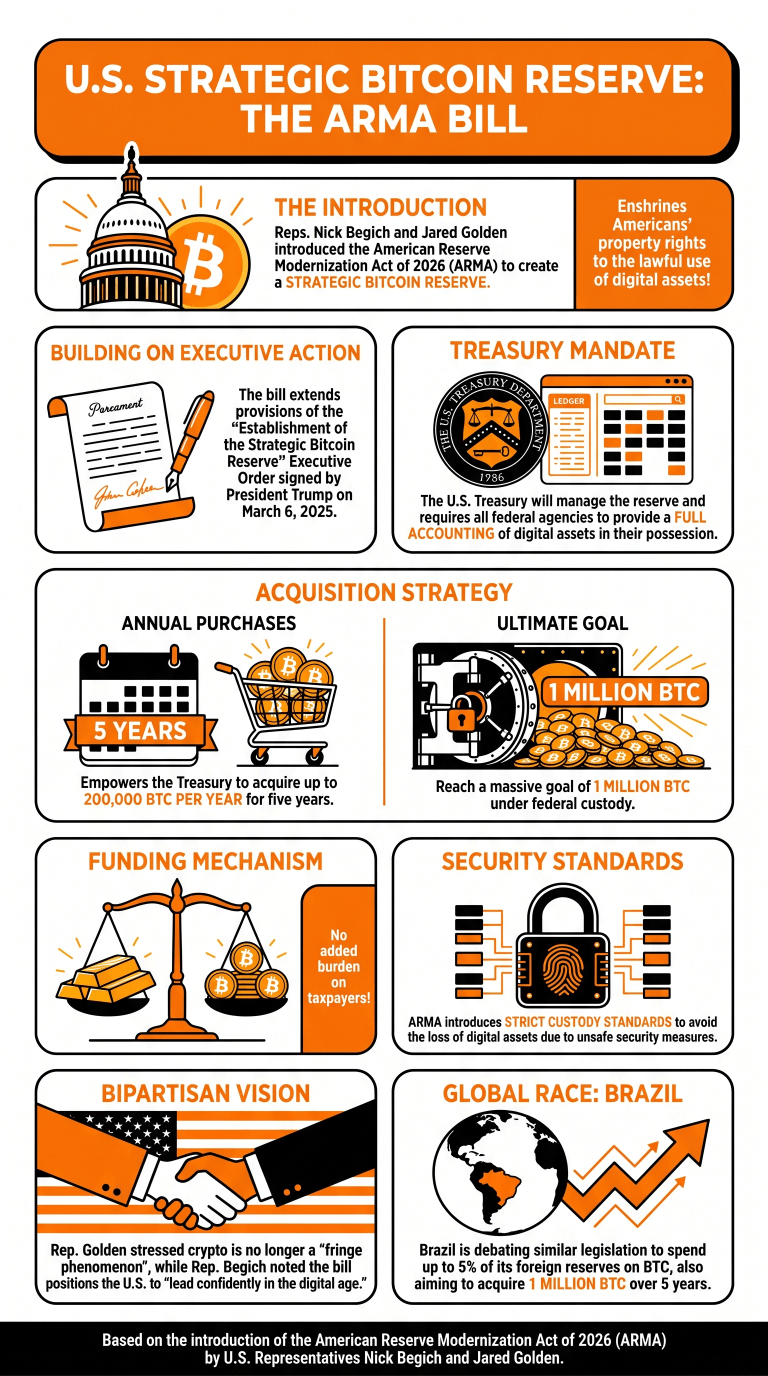
ARMA establishes a bitcoin reserve and a digital asset stockpile to be managed by the U.S. Department of the Treasury, and requires all federal agencies to provide a full accounting of digital assets held in their possession.
The legislation empowers the Treasury to acquire up to 200,000 BTC per year for five years, aiming to reach a goal of 1 million BTC under federal custody, building on what the Boosting Innovation, Technology, and Competitiveness through Optimized Investment Nationwide ( BITCOIN) Act, introduced by Senator Cynthia Lummis, had proposed before.
Under ARMA, bitcoin purchases would be conducted in a budget-neutral way, using gold revaluation to produce the funds needed for these acquisitions. It also introduces strict custody standards to avoid loss of digital assets due to unsafe security measures.
Begich stated that ARMA “positions the United States to lead confidently in the digital age while protecting taxpayer interests, strengthening financial sovereignty, and reinforcing the principles of transparency and sound stewardship,” also reinforcing the relevance of private property rights in the digital currency ecosystem.
Golden stressed that cryptocurrency was not the “fringe phenomenon” it was once, and that Congress was due to set policies on what to do with the bitcoin held by the U.S.
“Administrations have auctioned it off or held it in reserve, according to the whims of the executive branch. By creating a strategic reserve with the weight of law, the ARMA reinforces stability and gives Congress more time to establish long-term policy for how the federal government approaches cryptocurrency,” he concluded.
Similar legislation is currently being debated in Brazil, targeting spending of up to 5% of all the country’s foreign reserves on BTC. The bill also aims to acquire 1 million BTC over 5 years.