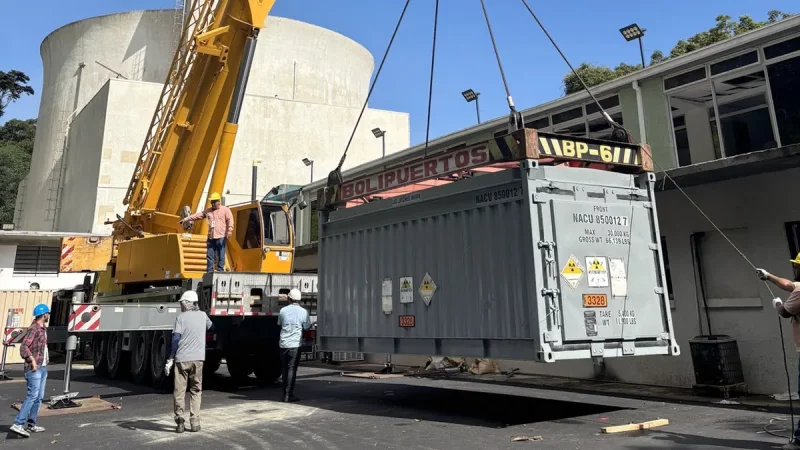
Venezuela just shipped its entire stockpile of highly enriched uranium to the United States. The 13.5 kilograms of HEU, roughly 30 pounds, traveled overland 100 miles to a Venezuelan port before crossing the Atlantic on a British vessel bound for South Carolina.
The US Department of Energy’s National Nuclear Security Administration announced the successful removal on May 9, marking a rare point of cooperation between Washington and Caracas during a period otherwise defined by sanctions, diplomatic friction, and mutual suspicion.
What happened and why it matters
The uranium came from Venezuela’s decommissioned RV-1 research reactor in Caracas, which ceased operations in 1991. It was enriched above 20%, a threshold that puts nuclear material into the “highly enriched” category and, in sufficient quantities, closer to the kind of material that could theoretically be weaponized.
The operation was conducted under the oversight of the International Atomic Energy Agency, with logistical support from the United Kingdom. The uranium is now headed to the Savannah River Site in South Carolina, a DOE facility where it will be downblended into high-assay low-enriched uranium, or HALEU, a fuel grade that’s becoming increasingly critical for next-generation nuclear reactors.
Advanced reactor designs from companies working on small modular reactors and other novel concepts need HALEU to operate, and domestic supply has been limited. Converting foreign HEU into usable reactor fuel reduces proliferation risk abroad while feeding energy ambitions at home.
A broader pattern of global HEU repatriation
This operation fits into a larger campaign that the NNSA has been running for over a decade. Since 2012, the US has repatriated approximately 6,000 kilograms of highly enriched uranium from more than 40 countries around the world.
Venezuela’s contribution of 13.5 kg represents the complete elimination of HEU from the country. The geopolitical context makes this particular transfer noteworthy beyond the nonproliferation math. Venezuela under Nicolás Maduro has not exactly been a cooperative partner for Washington on most fronts, and the fact that this operation happened at all suggests that nuclear security concerns can sometimes transcend even the most contentious bilateral relationships.