

Key Takeaways
- Tom Lee says the US-Iran war drove oil up and ETH down 28%, but expects a 2026 market recovery driven by tokenization and AI.
- Despite a 12% Bitcoin dip, Vitalik Buterin sees ETH thriving as an economic layer for AI agents.
- Dismissing short-term noise, BCG predicts asset tokenization will next hit $16T and 10% of GDP by 2030.
Fundstrat’s Tom Lee Predicts Stronger ETH Prices After Middle East War Ends
While the whole cryptocurrency market has been in decline since January, with bitcoin registering losses of 12% year to date, ether has it even rougher, losing nearly 28%.
Tom Lee, Chairman of Bitmine Immersion Technologies and Managing Partner and the Head of Research at Fundstrat Global Advisors, believes that, apart from the usual market headwinds, ether faces other difficulties due to the conflict in the Middle East.
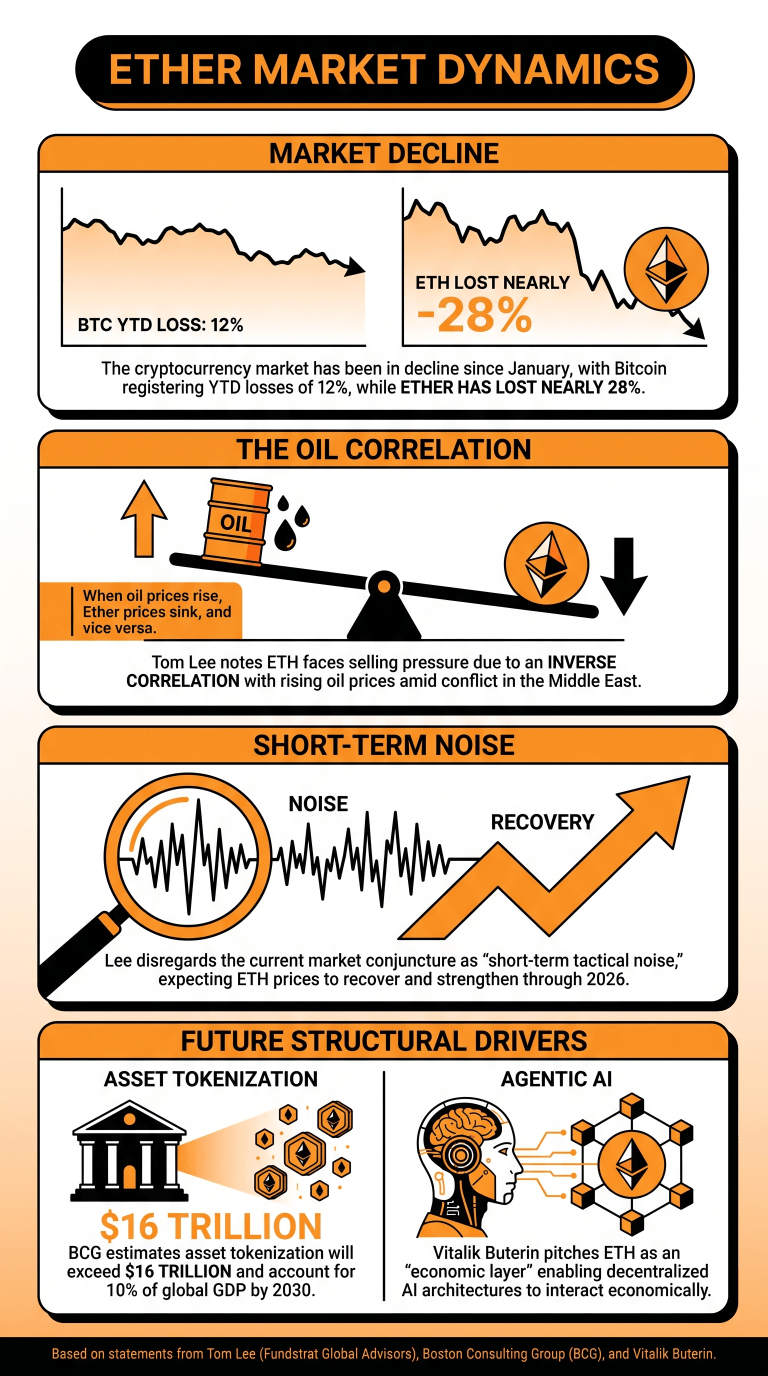
For him, one of the main reasons ETH has been facing increasing selling pressure is the rise in oil prices, as the cryptocurrency has been experiencing an inverse correlation with WTI indexes. This means that when oil prices rise, ether prices sink, and vice versa.
Numbers show that after the start of the war between the U.S. and Israel coalition against Iran, which caused increased volatility in international oil markets, the inverse correlation between ether’s price and oil prices reached its highest, pushing ETH prices lower.
Nonetheless, Lee disregarded this conjuncture as “short-term tactical noise,” stressing that the usual market drivers are still valid, including tokenization, which is still in its development stages across institutions, and Agentic AI.
“These structural drivers are in place. Thus, we expect ETH prices to be stronger as we move through 2026,” Lee concluded, hinting at a price recovery after the conflict in the Middle East ends.
Boston Consulting Group (BCG) estimates that asset tokenization will exceed $16 trillion and account for 10% of global GDP by 2030.
Ethereum co-founder Vitalik Buterin has pitched the ETH ecosystem as an “economic layer for AI-related interactions,” with the blockchain enabling “AIs to interact economically, which makes viable more decentralized AI architectures (as opposed to non-economic coordination between AIs that are all designed and run by one organization “in-house”).”