
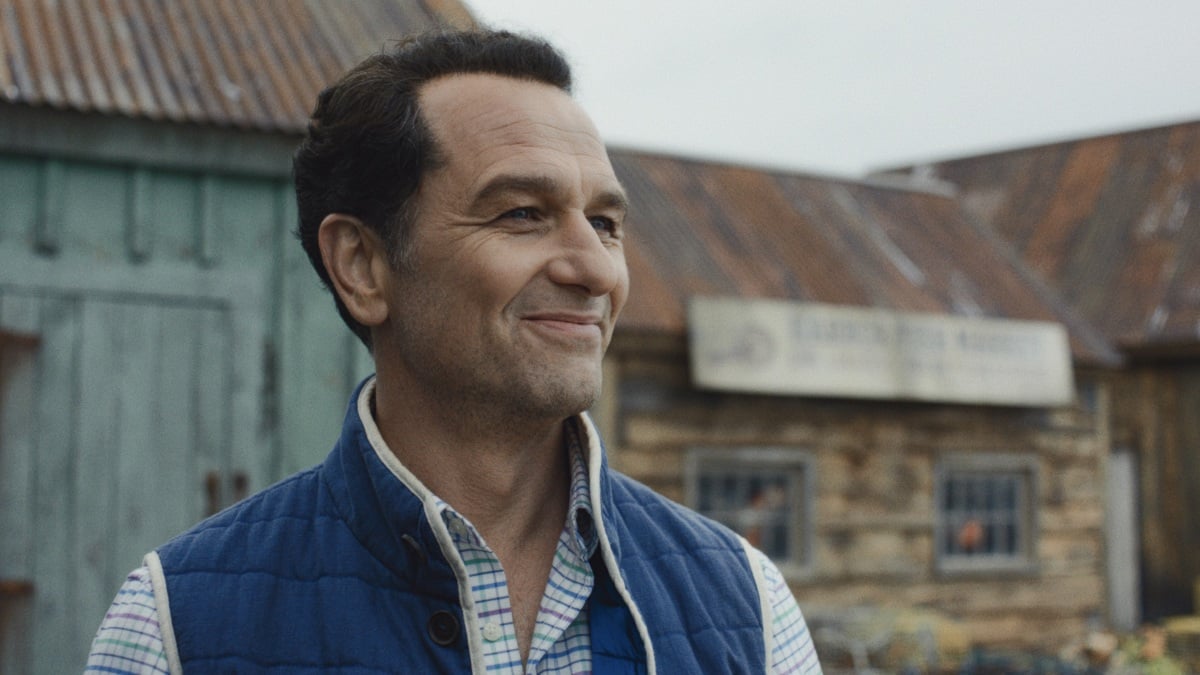
Cross the local bureaucratic comedy of Parks and Recreation with the small-town strangeness of Twin Peaks, and you’ll get a sense of the singular tone of Apple TV‘s new genre gem Widow’s Bay.
Created by Katie Dippold, herself a writer for Parks and Recreation, the series artfully blends horror and comedy to create an enthralling portrait of a town you’ll want to get lost in… even if some of its locals would advise you to run the hell away.
What’s Widow’s Bay about?

Matthew Rhys in “Widow’s Bay.”
Credit: Apple TV
A charming island 40 miles off the coast of New England, Widow’s Bay has a lot going for it. It boasts picturesque coastal views, invigorating ocean breezes, and atmospheric fog banks that have absolutely nothing hiding in them, do you hear me?
At least, that’s what Mayor Tom Loftis (Matthew Rhys) has to say. He’s trying to turn Widow’s Bay into the next Martha’s Vineyard, a quest that locals like former fisherman Wyck (Stephen Root) threaten to derail with their claims that Widow’s Bay is cursed.
Tom initially brushes Wyck and his allies off in favor of bringing in tourists. It’s a page straight from the playbook of Mayor Vaughn from Jaws, which Widow’s Bay pays loving homage to throughout. However, when haunts start knocking at his door, Tom has to face the truth: There’s something truly sinister at work on the island, and it’s only getting worse.
Widow’s Bay is a wonderfully frightening watch.

Matthew Rhys and Stephen Root in “Widow’s Bay.”
Credit: Apple TV
To pull off its many scares, Widow’s Bay draws inspiration from a wide range of horror iconography. Stephen King‘s influence hangs over the series like the town’s unshakeable mist, present in everything from the New England setting to the show’s title font, a clear nod to the style of his earlier covers.
The aforementioned Jaws plays a huge role, too, and not just because of Tom’s role as a skeptical, tourism-hungry mayor. (To Tom’s credit, he’s far less willing to put people in danger for the sake of money than Mayor Vaughn.) Root’s salty veteran sailor Wyck bears shades of Jaws‘ Quint, and an episode devoted to a cursed ocean outing recalls Jaws’ third act. But the biggest lesson Widow’s Bay takes from Stephen Spielberg’s horror classic is the fear of the unknown. Just as Jaws generates suspense by holding off on showing us its biggest threat until later in the runtime, so too does Widow’s Bay keep its viewers in the dark about its many frights.
Mashable Top Stories
And what darkness it is! Visually, Widow’s Bay thrives in rich, inky black tones where you can crucially still make out every little detail, a rarity in TV nowadays and a testament to the show’s production team and crew. Series directors Hiro Murai (Atlanta), Sam Donovan (Severance), Andrew DeYoung (Friendship), and Ti West (the X trilogy) weaponize this darkness — along with fog and ocean depths — to its fullest obscuring extent. That expert build-up of tension made the subsequent reveals hit all the harder, to the point that I couldn’t get through an episode without screaming or cackling. (Or, most often, some mix of both.)
Widow’s Bay nails the balance between scares and laughs.

Kate O’Flynn in “Widow’s Bay.”
Credit: Apple TV
Widow’s Bay‘s scares pull from sailor superstitions, classic slashers, and more, but they never feel cheap. That’s because the series roots them firmly in its characters’ anxieties, like Tom’s worries about tourism, or town hall staffer Patricia’s (Kate O’Flynn) desperate need to be liked. (She’s so desperate, in fact, that she may have falsely claimed to be the sole survivor of a serial killer who murdered some of her high school classmates.)
The latter produces a series highlight, an episode where a frantic Patricia attempts to host the perfect party. The social isolation she faces from her disdainful former classmates is just as wince-worthy as the uncanny events surrounding the event, resulting in a one-two punch of cringe comedy and horror.
Widow’s Bay often operates in that sweet spot between horror and comedy, which tends more toward the dry and bizarre than Dippold’s previous work on sitcoms like Parks and Recreation or comedy films like Ghostbusters (2016). Instead of cracking jokes at a mile per minute, Widow’s Bay finds the funny in the eerie. Think historical wax figures, a cursed party game called “Teeth,” and sight gags about cannibalism.
Widow’s Bay‘s central trio of Rhys, Root, and O’Flynn play these occurrences as straight as they can, adding further to the show’s brand of offbeat strangeness. Rhys and Root are tremendous foils as a skeptic and believer forced to work together. And O’Flynn proves an absolute scene stealer as Patricia, marrying her hilarious scorn for others with the genuine pain of being scorned right back.
The rest of Widow’s Bay‘s ensemble, which includes Somebody Somewhere‘s Emmy-winning Jeff Hiller, Dale Dickey, and several surprising guest stars, further builds out the town of Widow’s Bay. Their efforts, as well as the weatherbeaten production design by Steve Arnold (Midnight Mass, another superb cursed island series), turn Widow’s Bay into a real town. You can almost taste the salt air (or hear the screams of cursed souls in the distance) just by watching.
In the end, the town of Widow’s Bay is as deliciously odd as the show itself. What begins with a bit of a haunt-of-the-week structure soon evolves into a deeper unraveling of Widow’s Bay’s darkest secrets, as well as the choices that kept them in place. While I’d love for the show to return to its haunt-of-the-week mode occasionally, I also adore what it became. That it can pull off this transformation is proof of its sheer uniqueness. Forget being the next Martha’s Vineyard: Widow’s Bay sets a new, wonderfully weird course all by itself.
The first two episodes of Widow’s Bay premiere April 29, with new episodes every Wednesday.